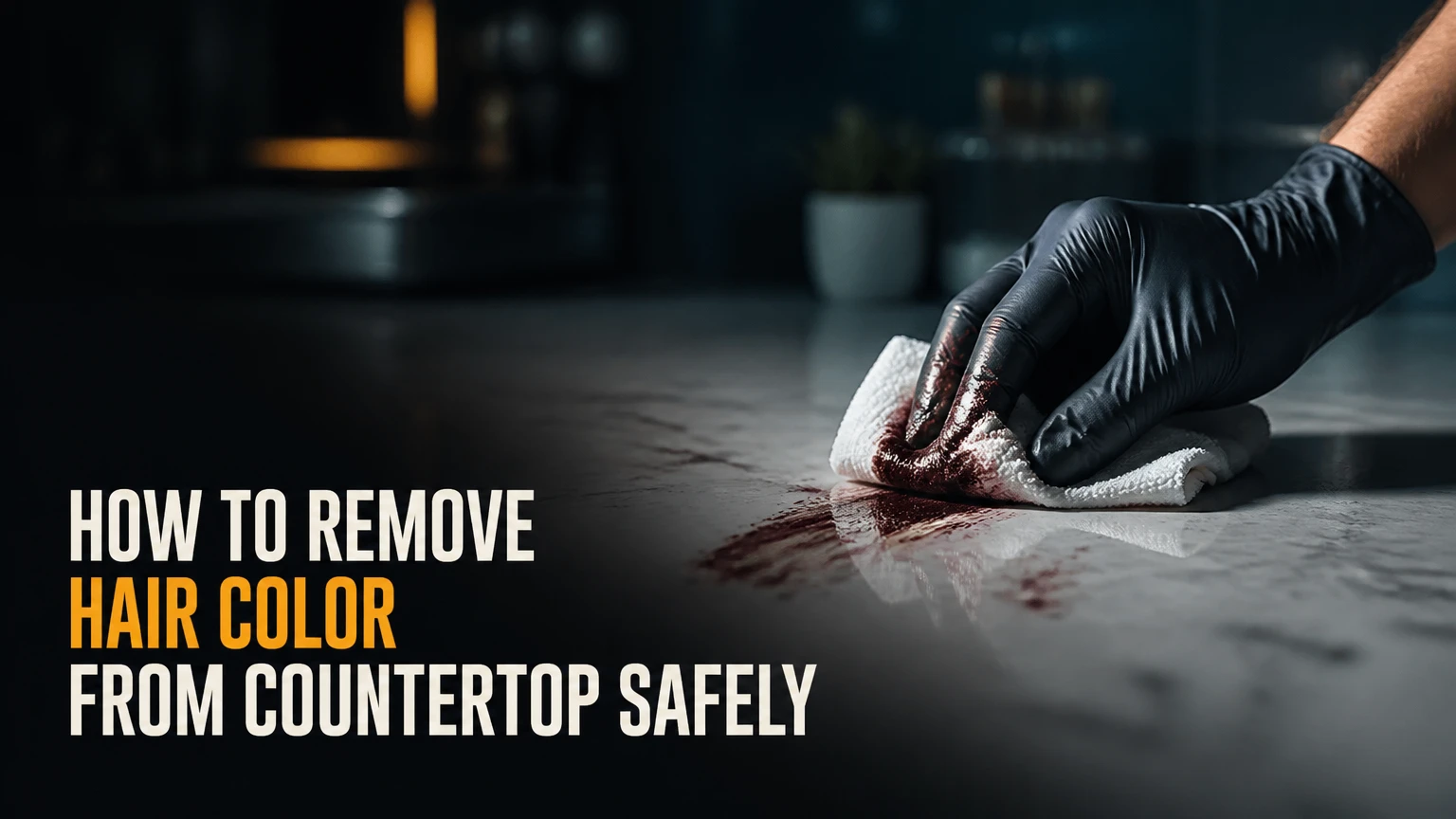
To remove hair color from a countertop, first lift fresh dye with dish soap and 70% isopropyl alcohol, then treat remaining pigment with a small paste of baking soda and 3% hydrogen peroxide. The safest product depends on the surface: avoid acids on marble, acetone on acrylic, and abrasive scrubbing on laminate or polished stone.
Key facts at a glance
Fresh hair dye usually responds best to blotting with 70% isopropyl alcohol before the pigment dries.
A paste made from 2 tablespoons of baking soda and 3% hydrogen peroxide can treat many sealed laminate, quartz, ceramic, and solid-surface counters.
Acetone can soften acrylic, attack some laminate finishes, and damage painted or varnished surfaces, so it is not a universal countertop cleaner.
Vinegar, lemon juice, and other acids can etch marble, limestone, travertine, and some cement-based surfaces.
A cured stain may need two or three short treatments, but repeated aggressive scrubbing can create permanent gloss loss.
Never combine chlorine bleach with ammonia, vinegar, alcohol, or other cleaners.
What Is Hair Dye Doing to a Countertop?
Hair dye stains form when colored molecules remain in microscopic pores, texture, seams, or a damaged sealer. Nonporous materials usually hold the dye on the surface, while porous stone, unfinished wood, grout, and worn laminate can absorb pigment below the visible finish.
Permanent hair color commonly contains oxidative dye precursors, alkalizing ingredients, and hydrogen-peroxide developer. Semi-permanent colors contain ready-made pigments that can transfer rapidly to wet surfaces. The dye does not always chemically bond to the counter itself; in many cases, the visible mark is pigment trapped in surface texture or held by a residue film.
Three removal actions explain most successful treatments:
| Removal action | What changes | Typical household agent | Main limitation |
|---|---|---|---|
| Dissolution | Loosens oily or polymeric color residue | Isopropyl alcohol | Can spread a wet stain if wiped sideways |
| Oxidation | Alters colored dye molecules | 3% hydrogen peroxide | May lighten some finishes or dyes unevenly |
| Mechanical lifting | Removes pigment from texture | Baking soda paste, microfiber cloth | Excess pressure can dull gloss |
| Detergency | Suspends developer, oils, and loose pigment | Dish soap and warm water | Weak against a fully cured stain |
The important distinction is between a stain and surface damage. A stain changes the color of the residue. Etching changes the surface texture, while solvent damage can soften, whiten, or remove the finish. A whitening mark that remains after the dye is gone is probably not a remaining stain.
What Is the Countertop Made Of?
Identify the material before choosing a solvent. A manufacturer label, installation invoice, underside marking, or a hidden area beneath a small appliance can help distinguish quartz composite from natural stone, laminate, acrylic solid surface, or painted wood.
| Countertop material | Porosity or finish | Lowest-risk first treatment | Products to avoid first |
|---|---|---|---|
| Plastic laminate | Low porosity, resin face | Dish soap, then brief alcohol | Acetone, steel wool, prolonged peroxide |
| Quartz composite | Very low porosity, resin binder | Dish soap, alcohol, diluted peroxide spot test | Abrasive powder, strong bleach, heat |
| Granite | Variable porosity, sealer-dependent | pH-neutral cleaner, brief alcohol test | Vinegar, lemon, abrasive scouring |
| Marble or limestone | Porous, acid-sensitive carbonate stone | pH-neutral cleaner, careful peroxide test | Vinegar, lemon, acidic bathroom cleaner |
| Acrylic solid surface | Nonporous thermoplastic | Dish soap, manufacturer-approved cleaner | Acetone, lacquer thinner, strong solvents |
| Ceramic or porcelain tile | Glazed and low porosity | Dish soap, alcohol, peroxide | Metal scraping on glaze or grout |
| Glass | Nonporous mineral surface | Alcohol, glass cleaner, acetone spot test | Abrasive pads and gritty powders |
| Finished wood or veneer | Finish-dependent, sometimes porous | Dish soap on a damp cloth, then stop | Acetone, peroxide soaking, excess water |
Quartz is engineered stone, not the same material as granite or marble. Quartz surfaces contain a resin binder, so a chemical that is acceptable on briefly tested natural stone can still dull or discolor a quartz finish. Consult the specific brand instructions for Caesarstone, Cambria, Silestone, MSI, or another manufacturer before using a strong product.
The Natural Stone Institute recommends neutral cleaners for stone maintenance because acidic household products can react with calcite-rich surfaces. That guidance matters more than a generic “natural cleaner” label when the counter is marble, limestone, or travertine.
Which Cleaner Is Safest?
For an unidentified countertop, start with dish soap and water, test 70% isopropyl alcohol in a hidden spot, and reserve peroxide paste for a small remaining mark. This sequence removes loose dye before introducing oxidation or abrasion, which reduces both spreading and finish damage.
| Cleaner or method | Fresh dye | Cured dye | Typical contact time | Relative risk |
|---|---|---|---|---|
| Warm water and dish soap | High | Low | 1-3 minutes | Very low |
| 70% isopropyl alcohol | High | Medium | 30-60 seconds per pass | Low to medium |
| 3% hydrogen peroxide paste | Medium | Medium to high | 10-30 minutes | Low to medium |
| Acetone | High | High | 15-30 seconds | Medium to high |
| Chlorine bleach | Medium | Medium | Product-label time | High |
| Melamine sponge | Medium | Medium | 5-10 light strokes | Medium |
| Commercial dye remover | Medium to high | High | Label-specific | Product-dependent |
The table describes practical household performance, not a controlled comparison across every dye formula. Hair colors vary by pigment, developer, ammonia or ethanolamine content, and brand, while countertop finishes vary by age and wear.
Why is 70% isopropyl alcohol useful?
Isopropyl alcohol loosens fresh color transfer and evaporates quickly, making it a practical first solvent for many sealed counters. Alcohol works best before the dye dries into surface texture, and blotting is safer than wiping because lateral wiping spreads liquid into grout lines, seams, and textured laminate.
Use a white cotton pad or white microfiber cloth. Colored cloth can release its own dye and make the result harder to judge.
How Do You Remove Fresh Hair Color?
Fresh hair color can usually be removed in four controlled stages: contain the spill, wash away the surface film, blot with alcohol, and treat any remaining shadow. The full process typically takes 5-15 minutes when the stain is still wet.
Before you start
| Requirement | Typical amount or value | Why it matters |
|---|---|---|
| Time | 5-15 minutes | Fresh pigment is easier to lift |
| Cost | $0.25-$2 per treatment | Uses common household supplies |
| Dish soap | 1 teaspoon | Suspends loose dye and oils |
| 70% isopropyl alcohol | 1-2 tablespoons | Provides controlled solvent contact |
| White microfiber cloths | 2-3 cloths | Separates dirty and clean wiping stages |
| Cotton pads | 2-4 pads | Limits the contaminated area |
| Nitrile gloves | 1 pair | Protects skin from dye and solvent |
- Contain the spill. Put on gloves and place a dry paper towel around the outside edge of the mark. Lift excess dye vertically rather than dragging the towel across the counter. You will know this step worked when the wet perimeter stops expanding. A common mistake is adding water immediately, which can carry pigment into a seam.
- Wash the surface film. Mix 1 teaspoon of dish soap with about 250 milliliters of warm water. Wipe once with a damp white cloth, rinse the cloth, and wipe again with clean water. The dye should become less glossy and less slippery. Do not flood an unfinished wood edge or a counter seam.
- Blot with alcohol. Saturate a cotton pad with 70% isopropyl alcohol, press it onto the mark for 30 seconds, then lift straight upward. Repeat with a clean pad until little or no color transfers. A side-to-side wipe is the main failure at this stage because it enlarges the stain.
- Rinse and dry. Wipe the area with clean water, then dry it with a fresh microfiber cloth. A successful result leaves the original sheen and no sticky film. If a colored shadow remains, use the peroxide method rather than increasing alcohol contact indefinitely.
The Centers for Disease Control and Prevention identifies 70% alcohol as an effective concentration for many disinfection applications, but disinfection guidance is not the same as countertop-finish guidance. Alcohol can still affect some painted, coated, or plastic surfaces, so a hidden-spot test remains necessary.
How Do You Use Baking Soda and Hydrogen Peroxide?
A baking soda and 3% hydrogen peroxide paste is a reasonable second treatment for a persistent mark on many sealed counters. Mix 2 tablespoons of baking soda with enough peroxide to make a thick paste, apply it for 10-30 minutes, remove it gently, and rinse without allowing residue to dry.
- Test first. Put a pea-sized amount on an inconspicuous area for 10 minutes. Check for whitening, roughness, color change, or gloss loss after rinsing and drying.
- Mix the paste. Use 2 tablespoons of baking soda and add 3% hydrogen peroxide a few drops at a time. A toothpaste-like paste should stay in place instead of running toward a backsplash or seam.
- Apply without scrubbing. Dab a layer approximately 2-3 millimeters thick over the dye. Avoid spreading it beyond the mark because peroxide can lighten some colored finishes unevenly.
- Control the dwell time. Leave the paste for 10 minutes on laminate or quartz and up to 30 minutes on a tested ceramic or solid-surface area. Do not begin with a two-hour soak. Long contact increases finish risk without guaranteeing deeper pigment removal.
- Lift, rinse, and inspect. Remove the paste with a damp microfiber cloth, rinse twice with clean water, and dry. The surface should look even under angled light. A chalky haze means the baking soda was not fully rinsed.
Baking soda is a mild abrasive, not a chemical solvent. Pressing harder does not make peroxide work faster. It can instead create a polished spot, matte patch, or fine scratch pattern that remains after the dye disappears.
How Much Time and Money Does Removal Take?
Most household hair-color stains cost less than $10 to treat and take 5-30 minutes, depending on the surface and the age of the pigment. Professional stone polishing, laminate replacement, or a damaged acrylic repair can cost substantially more than the cleaning materials.
| Situation | Supplies | Typical treatment time | Typical household cost |
|---|---|---|---|
| Fresh mark on laminate | Soap, alcohol, cloth | 5-10 minutes | $1-$4 |
| Dried mark on quartz | Peroxide, baking soda, cloth | 20-45 minutes | $1-$5 |
| Dye in ceramic grout | Soap, peroxide, soft brush | 15-40 minutes | $2-$8 |
| Absorbed pigment in marble | Stone cleaner, tested poultice | 30-120 minutes | $5-$20 |
| Solvent-damaged finish | Repair polish or refinishing service | 1-3 days | $50-$500+ |
These are typical North American retail ranges, not fixed prices. Local prices vary by country, product size, countertop brand, and whether a technician must polish, reseal, or replace the affected section.
What Changes for Quartz, Stone, Wood, or Acrylic?
Countertop material changes the safe treatment more than dye brand does. Sealed quartz and laminate generally tolerate the mild methods described above, while marble, unfinished wood, painted surfaces, and acrylic require shorter contact times and fewer chemicals.
| Material | Recommended sequence | Maximum first contact | Repair warning |
|---|---|---|---|
| Laminate | Soap, alcohol test, brief peroxide | 10 minutes peroxide | Gloss changes indicate resin damage |
| Quartz | Soap, alcohol test, peroxide spot test | 10-15 minutes peroxide | Dull or pale patch may be resin damage |
| Granite | Neutral cleaner, alcohol test, stone poultice | 30-60 seconds alcohol | Dark halo may indicate absorption |
| Marble | Neutral cleaner, professional poultice if needed | 30 seconds test only | Dull patch is etching, not dye |
| Acrylic | Soap and water, approved cleaner | 30 seconds test only | Softness or tackiness means solvent attack |
| Finished wood | Damp soap cloth, immediate drying | 30 seconds moisture test | Swelling or whitening needs refinishing |
| Ceramic tile | Soap, alcohol, peroxide | 30 minutes tested glaze | Grout may retain pigment below surface |
Quartz
Use dish soap first, followed by a brief alcohol test on a hidden location. For a remaining mark, use the peroxide paste for 10-15 minutes and rinse thoroughly. Do not use abrasive scouring powder, steel wool, prolonged bleach, or high heat.
Quartz stains can appear permanent when pigment sits at the edge of a sink cutout or in a textured finish. A soft nylon brush may help in a joint, but it should not be used with force on the open counter surface.
Granite
Sealed granite usually tolerates a short alcohol test, but the stone can absorb pigment through worn sealer or an unsealed edge. If the stain darkens the stone, stop repeated wiping and use a stone-safe poultice or contact a stone-care professional.
Do not use vinegar or lemon juice. Carbonate minerals in some natural stones react with acids, producing a dull etched area that polishing, not stain removal, must correct.
Marble, limestone, and travertine
Use a pH-neutral stone cleaner and a white cloth. A tested 3% peroxide treatment may help some organic color marks, but marble-care guidance should take precedence over generic hair-dye recipes. Never scrub an etched area in an attempt to restore shine.
Acrylic and solid surface
Acrylic solid-surface counters are vulnerable to acetone, nail-polish remover, lacquer thinner, and other aggressive solvents. Use soap and water, then only a cleaner named in the manufacturer’s care instructions. A softened or cloudy patch requires surface repair, not additional dye remover.
Wood, veneer, and painted counters
Wood and veneer are the highest-risk household surfaces because pigment can enter the finish or exposed fibers. Keep moisture and peroxide localized, avoid soaking, and stop if the color remains after two gentle passes. Sanding can remove a stain but also removes the finish and may create a visible lighter patch.
Can You Use Acetone or Nail-Polish Remover?
Acetone is effective against some dried hair colors, but it is suitable only for a confirmed compatible surface and a very short contact time. Glass and some glazed ceramic are the safest candidates; acrylic, finished wood, painted counters, many laminates, and unknown plastics should not receive acetone.
If the surface is confirmed compatible, place a few drops on a white cotton swab, touch the stain for 15-30 seconds, and wipe immediately with water. Never pour acetone directly onto the counter. A nail-polish remover may contain water, fragrance, oils, ethyl acetate, or other additives, so its behavior differs from pure acetone.
| Acetone situation | Decision | Reason |
|---|---|---|
| Glass countertop | Usually acceptable after spot test | Glass is chemically resistant to brief contact |
| Glazed ceramic | Often acceptable after spot test | Glaze protects the ceramic body |
| Quartz composite | Avoid as a default | Resin binders can react or discolor |
| Plastic laminate | Avoid unless manufacturer approves | Finish and adhesive layers vary |
| Acrylic solid surface | Do not use | Acetone can soften or craze acrylic |
| Finished wood | Do not use | Can strip varnish, lacquer, or paint |
| Unknown material | Do not use | Damage can occur before compatibility is known |
The common claim that acetone is safe for all quartz and granite is too broad. Some product-care instructions permit brief solvent use for specific substances, but a countertop manufacturer’s instructions control because resin systems, sealers, and finishes differ.
What Can Replace Peroxide or Alcohol?
Dish soap is the safest universal starting point, while a manufacturer-approved commercial countertop cleaner is the safest choice when the material is uncertain. For natural stone, a pH-neutral cleaner and a stone poultice are better alternatives than vinegar, lemon, abrasive powder, or untested bleach.
| Alternative | Best use | Quantity or application | Avoid when |
|---|---|---|---|
| Dish soap | Fresh surface residue | 1 teaspoon in 250 ml water | Stain has penetrated stone |
| pH-neutral stone cleaner | Marble, granite, limestone | Label dilution | Product contains acid |
| Commercial dye remover | Cured pigment on approved material | Label-specific | Material is absent from label |
| 3% peroxide alone | Small light-colored residue | Cotton swab, 5-10 minutes | Finish is colored or untested |
| Soft nylon brush | Textured grout or seams | 5-10 light strokes | Polished surface |
| Stone poultice | Absorbed pigment | Product-specific, often hours | Countertop is nonporous laminate |
Commercial hair-color removers can contain reducing agents, sulfites, persulfates, or strong alkalines. A product formulated for hair is not automatically formulated for laminate, stone, acrylic, or paint. Read the surface-compatibility statement and test a hidden area.
Hair electrolysis does not remove countertop dye. Electrolysis targets individual hair follicles through a probe and electrical current; it has no useful role in dissolving or oxidizing pigment on a counter. Do not substitute electrolysis equipment or salon chemicals for a surface-safe cleaner.
How Do You Remove Dried Hair Dye?
Dried hair dye needs softened contact and repeated short treatments, not immediate heavy scrubbing. Start with a damp soapy cloth for 2-3 minutes, use a tested alcohol or peroxide treatment, and stop after two or three cycles if the surface begins to change.
- Cover the mark with a cloth dampened in warm soapy water for 2 minutes.
- Lift softened residue with a plastic card held nearly flat, provided the material is not delicate or easily scratched.
- Test 70% isopropyl alcohol for 30 seconds and blot.
- Apply peroxide paste for 10-30 minutes, according to the material table.
- Rinse twice and dry before judging the color.
- Wait at least 30 minutes between cycles so gloss and color changes become visible.
For an absorbed stone stain, a poultice may need several hours or an overnight dwell according to the product label. Covering a poultice with plastic can prevent premature drying, but it should not be improvised on a resin countertop without manufacturer approval.
A stain that lightens after each cycle is responding. A stain that does not change after two cycles may be below the sealer, chemically fixed in a finish, or located in a porous material. More pressure is not a reliable solution.
What Mistakes Cause Permanent Damage?
The most expensive mistakes are usually chemical or mechanical, not a failure to use a stronger dye remover. Surface repair becomes necessary when a cleaner changes gloss, texture, color, or sealer integrity.
- Using steel wool or a metal scraper: Metal creates scratches in laminate, quartz resin, acrylic, and polished stone. Use a plastic card only on a tested, hard surface.
- Scrubbing dry baking soda: Dry powder increases friction. Keep the paste wet and use light pressure.
- Using vinegar on marble: Vinegar can etch calcium-carbonate stone. The resulting dull patch is surface loss, not residual hair color.
- Leaving bleach on a dark counter: Oxidation can lighten the countertop itself. Bleach can also damage sealers and create fumes.
- Mixing cleaners: Bleach with ammonia can form chloramines, and bleach with acids can release chlorine gas. Alcohol should also remain separate from bleach.
- Flooding seams and edges: Liquid can enter particleboard, plywood, caulk, or adhesive layers beneath the decorative surface.
- Using a melamine sponge repeatedly: A melamine sponge acts as a fine abrasive and can create a visibly dull patch on glossy finishes.
Practitioner rule: If the mark is smaller than a coin, use a cotton swab or cotton pad rather than applying cleaner over an entire counter section. Smaller application areas reduce halos, uneven bleaching, and accidental contact with seams.
Counterintuitive truth: A countertop can look whiter after cleaning because the finish was abraded, not because the dye was removed. Always inspect the area after it dries under side lighting.
What If the Stain Will Not Disappear?
If hair dye remains after two gentle treatment cycles, identify whether the counter is stained, etched, solvent-damaged, or structurally porous. Stop cleaning when the mark changes from colored pigment to a pale, dull, cloudy, sticky, or rough patch, because additional chemicals may worsen the defect.
| Visible result after treatment | Likely cause | Correct next action |
|---|---|---|
| Purple, red, blue, or black shadow | Remaining pigment | One material-approved treatment |
| Dull ring with no color | Acid or abrasive etching | Stone polishing or finish restoration |
| White cloudy patch | Solvent or sealer damage | Manufacturer or refinisher assessment |
| Sticky or softened area | Plastic or coating attack | Stop solvents immediately |
| Dark edge around a seam | Absorption below surface | Poultice or professional repair |
| Raised residue | Dried product film | Plastic card and mild detergent |
For marble and other polished stone, a professional may need to hone and repolish the affected area, then reseal it. For laminate, a small finish defect may require replacement of the top layer or a matching repair product. For acrylic, a trained fabricator can often sand and refinish a localized mark, but DIY solvent experiments can enlarge the repair.
Photograph the area before further treatment, especially in a rental property. A dated image helps distinguish the original stain from later cleaning damage.
How Can You Prevent the Next Stain?
Preventing transfer is easier than removing cured pigment because hair dye can dry within minutes in a warm, dry bathroom. Cover the counter with a disposable plastic barrier, keep a damp white cloth beside the mixing bowl, and wipe drips before applying heat or styling products.
Use this salon-style setup:
- Place a washable silicone mat or plastic barrier under the bowl and brush.
- Keep separate damp and dry white cloths within reach.
- Wipe drips immediately with dish-soap solution.
- Keep developer, dye, bleach powder, and remover bottles inside a tray.
- Rinse the counter after the coloring process and dry the edges.
- Do not leave stained gloves, towels, or foil on the countertop.
Permanent hair color often transfers from gloves and wet hair after processing, so inspect the faucet base, backsplash joint, sink rim, and drawer pulls. These locations commonly retain more pigment than the open counter because moisture collects there.
Frequently Asked Questions
Will baking soda alone remove hair dye from a counter?
Baking soda alone may lift a fresh surface mark through mild abrasion, but it is less effective against cured pigment than dish soap followed by a tested solvent or 3% hydrogen peroxide. Use a wet paste and light pressure. On polished stone, quartz, and glossy laminate, excessive rubbing can create a dull patch.
Can Magic Eraser remove hair color from laminate?
A Magic Eraser can remove some surface dye from laminate because melamine foam is mildly abrasive. Use no more than 5-10 light strokes on a wet area, then rinse and inspect. The foam can reduce gloss on dark or high-shine laminate, so isopropyl alcohol is usually the lower-abrasion choice.
How do you remove black hair dye from a white countertop?
Remove black dye from a white countertop by washing with dish soap, blotting with 70% isopropyl alcohol, and applying a tested 3% peroxide paste for 10-30 minutes. White quartz, ceramic, and solid surface usually tolerate this sequence better than white acrylic, painted wood, or marble.
Does hair dye permanently stain quartz?
Hair dye does not always permanently stain quartz because quartz composite has a low-porosity surface, but pigment can remain in texture, seams, damaged resin, or an edge. Use manufacturer-approved cleaner first. A persistent pale or glossy patch after cleaning indicates finish damage rather than dye.
Can bleach remove hair dye from a marble countertop?
Bleach is not a safe first choice for a marble countertop. Bleach may lighten the pigment, but marble can also develop discoloration, sealer damage, or an uneven appearance. Use a pH-neutral stone cleaner and seek a stone-safe poultice or professional advice for an absorbed stain.
When should a countertop professional repair the mark?
Contact a countertop professional when the surface becomes dull, cloudy, rough, sticky, swollen, or lighter than the surrounding area, or when two gentle treatments fail on porous stone. Stone polishing, resealing, laminate repair, and acrylic refinishing address surface damage that household stain removers cannot reverse.
The Bottom Line
The safest way to remove hair color from countertop surfaces is to match the treatment to the material and stain age. Use dish soap first, blot fresh dye with tested 70% isopropyl alcohol, and apply a small 3% hydrogen peroxide and baking soda paste for a remaining mark. Avoid acetone on acrylic, wood, painted counters, and unknown laminate; avoid acids on marble; and stop when the surface changes rather than continuing to scrub.