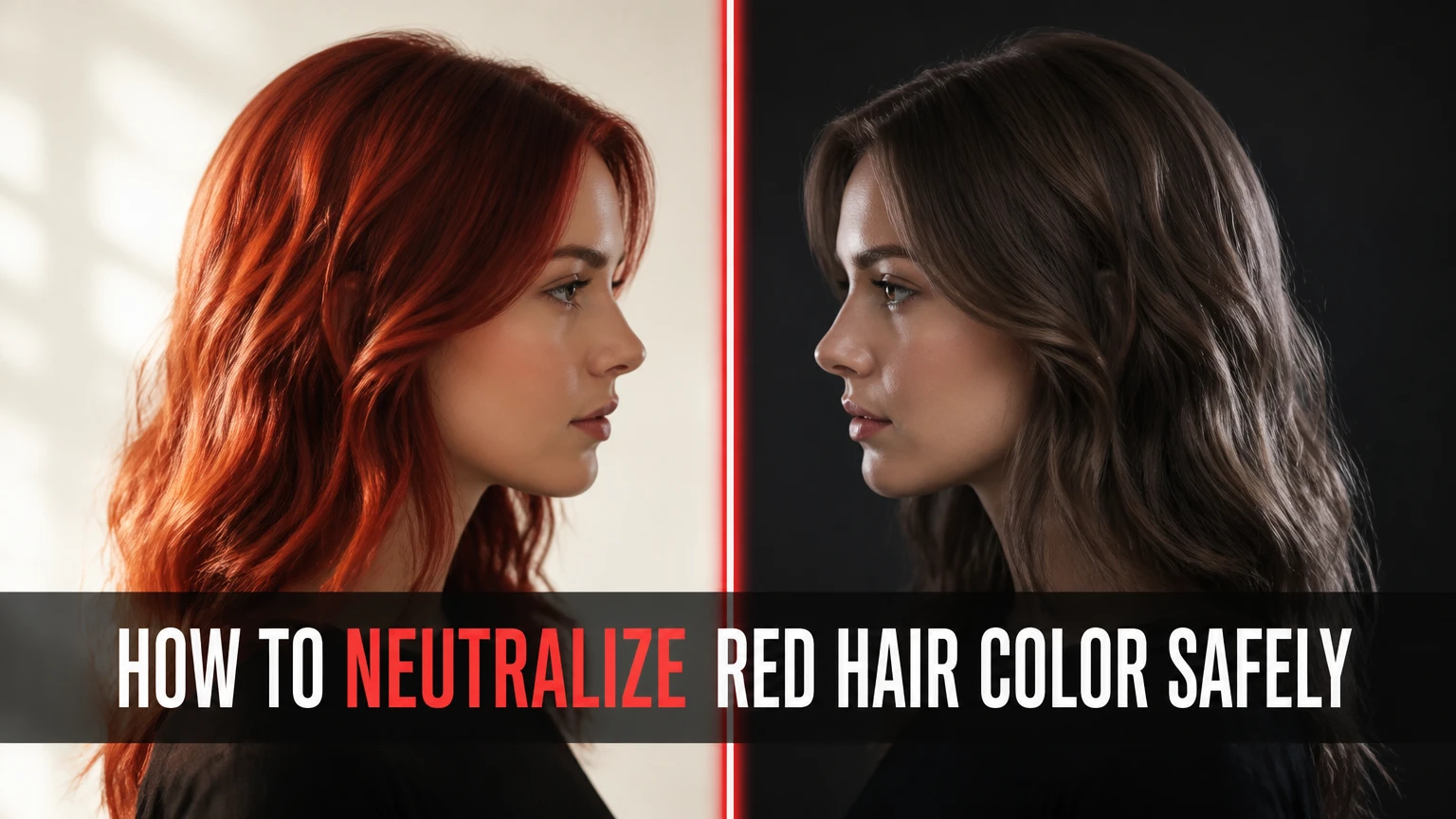
To neutralize red hair color, identify whether the unwanted warmth is true red, red-orange, orange, or yellow, then apply the matching cool pigment. Green counteracts true red, blue counteracts orange, and violet counteracts yellow. Deposit-only products can balance tone, but they cannot lighten hair or reliably remove deeply saturated permanent red dye.
Key Facts at a Glance
Green is the complementary color for true red hair.
Blue is more appropriate when the warmth is orange or red-orange.
Toner deposits corrective pigment; it does not lift dark artificial color.
Porous, bleached hair absorbs cool pigment faster and can turn muddy or green.
A strand test is the safest way to determine processing time.
Permanent red dye usually requires color removal, recoloring, or professional correction rather than repeated toner.
Which Color Neutralizes Red Hair?
Green neutralizes true red because green sits opposite red in the traditional hair-color correction wheel. The correct product is usually labeled green, matte, ash-matte, or with a manufacturer-specific reflect code associated with green pigment. Color codes are not universal, so the label and brand chart matter more than a number such as “.7.”
Red-orange hair needs a balanced formula rather than automatically using pure green. A green-only product can leave a khaki cast when the hair also contains orange or yellow. The target shade, current level, artificial dye history, and porosity determine the final formula.
Is the Warmth Red, Orange, or Yellow?
Diagnose the visible reflection in daylight before choosing a corrective pigment. A red reflection resembles copper, cherry, burgundy, or mahogany; orange looks like copper penny or pumpkin; yellow resembles straw or gold. A bathroom’s warm lighting can make orange appear red, so compare the hair beside a white towel near a window.
| Visible warmth | Complementary pigment | Common product label | Typical target level |
|---|---|---|---|
| Red or cherry red | Green | Matte, green, ash-matte | Levels 2-5 |
| Red-orange or copper red | Green plus blue balance | Matte-ash, blue-green | Levels 5-6 |
| Orange or copper | Blue | Ash, blue, blue-violet | Levels 6-7 |
| Yellow or gold | Violet | Pearl, violet, ash-violet | Levels 8-10 |
Hair levels run approximately from 1, the darkest black, through 10, the palest blonde. The lighter the hair, the less likely “red” is the actual dominant problem. A level 7 described as red may contain mostly orange, while a level 5 brown may contain genuine red underlying pigment.
Why Does Red Hair Color Need Green Pigment?
Hair color correction works through selective light absorption. Red dye reflects red wavelengths strongly, while a controlled amount of green pigment reduces that reflection and makes the result appear browner or more neutral. The process changes visual balance through pigment deposition rather than removing every warm molecule from the fiber.
Natural hair also exposes warm underlying pigment when lightening occurs. Dark brown hair commonly reveals red and red-orange beneath its surface, while medium brown hair often exposes orange and gold as it becomes lighter. The visible warmth therefore may come from natural pigment, artificial dye, fading, or a combination of all three.
What Neutralization Cannot Do
Neutralization cannot lift a level 4 red permanent dye to level 8 blonde. A green conditioner may make the surface appear less red, but the hair remains approximately the same depth and still contains the original dye molecules.
Hair color products also cannot safely reverse every color result in one application. A remover may reduce oxidative artificial dye, but it may not remove direct dyes, metallic salts, or all red staining. Bleach can remove more pigment while also increasing structural damage, so correction should progress from the least aggressive suitable method.
Which Method Fits the Strength of the Red?
Green shampoo or a green conditioning mask suits faint, fading warmth. A demi-permanent toner suits moderate warmth on relatively healthy hair at the correct depth. Strong, uneven, or artificially saturated red usually needs a color-removal plan, and severe banding or breakage warrants a stylist.
| Method | Pigment action | Typical duration | Typical cost |
|---|---|---|---|
| Green shampoo | Light surface deposit | 1-3 washes | $10-$30 |
| Green conditioning mask | Moderate direct deposit | 2-8 washes | $15-$40 |
| Demi-permanent toner | Controlled oxidative deposit | 4-6 weeks | $15-$45 |
| Salon correction | Customized removal and recoloring | 4-12 weeks per service | $75-$300+ |
When Should You Use Green Shampoo?
Use green shampoo when the red is mild, diffuse, and already close to the desired depth. Apply it once weekly at first, leave it on for the product’s stated time, and inspect the result after rinsing. Pigmented shampoos are maintenance products, not reliable solutions for vivid red box dye.
Green shampoo can build unevenly because porous ends absorb more pigment than healthy roots. A green conditioner or mask often gives better control because the application can be placed only on warm areas. Use gloves when the product is strongly pigmented.
When Is a Demi-Permanent Toner Better?
A demi-permanent toner is more suitable when red warmth is moderate and the hair already has the correct lightness. Demi-permanent color generally deposits or blends tone with lower alkalinity and lower developer strength than permanent color, but formulas differ substantially by brand.
Do not select a toner by the word “ash” alone. Some ash shades contain blue, some contain blue-violet, and some contain green or a blend of cool pigments. Read the brand’s color chart, identify the dominant warmth, and compare the toner’s depth with the hair’s existing level.
Why Is Permanent Dye Usually a Poor First Fix?
Permanent dye is not automatically a stronger or safer toner. Permanent color can alter natural pigment, expose additional warmth, increase dryness, and create a new band where previously colored hair responds differently from virgin growth.
A permanent matte shade may camouflage red on healthy, evenly colored hair, but it does not reliably erase vivid fashion red or correct uneven saturation. Repeated permanent color can make future lightening more difficult. Use it only when a professional formula or a carefully matched at-home system is appropriate.
How Should You Choose a Toner Formula?
Choose the corrective tone by dominant warmth, desired depth, and hair porosity. Use the lowest-strength deposit system that can produce the needed change, and follow the product’s mixing ratio instead of assuming that every toner uses a 1:1 formula.
| Hair condition | Dominant issue | Safer starting option | Processing approach |
|---|---|---|---|
| Healthy level 4 brown | True red | Level 4-5 matte demi | Strand test, inspect every 5 minutes |
| Healthy level 5 copper brown | Red-orange | Balanced matte-ash demi | Avoid pure green if orange dominates |
| Level 7 orange blonde | Orange | Blue or blue-violet toner | Use a blonde-compatible formula |
| Bleached, porous level 8 | Faint warm cast | Tinted conditioner or mask | Short exposure, frequent visual checks |
| Vivid direct red | Saturated artificial dye | Direct-dye remover or salon assessment | Do not pile green over heavy red |
Developer volume is not a universal strength scale for toning. Many professional demi systems use low-volume activators, while some acidic glosses use a dedicated lotion and some direct dyes use no developer. A 10-volume developer is not automatically correct for every product.
How Do You Perform a Strand Test?
Mix the proposed product exactly as directed, then apply it to a hidden strand with the same porosity and color history as the visible hair. Check the strand at five-minute intervals and record the time when the red looks balanced without a gray, green, or muddy cast.
A strand test reveals three separate risks: excessive darkening, uneven absorption, and an incorrect complementary pigment. If the test fails, do not compensate by leaving the full application on longer. Change the formula or ask a colorist to assess the underlying pigment.
How to Neutralize Red Hair Color at Home
A controlled at-home correction takes approximately 30-60 minutes, excluding a patch-test waiting period, and the success factor is accurate diagnosis rather than maximum processing time. The procedure below suits mild to moderate red warmth on intact hair, not severe chemical damage or a vivid permanent color correction.
Before You Start
| Requirement | Typical specification | Why it matters |
|---|---|---|
| Time | 30-60 minutes | Includes application, checks, and rinsing |
| Tools | Gloves, bowl, brush, clips, timer | Supports controlled saturation |
| Product | Green, matte, or balanced corrective formula | Must match the dominant warmth |
| Hair state | Clean, detangled, damp or dry as directed | Brand instructions determine application state |
| Safety | Patch test and strand test | Reduces allergy and over-deposit risk |
Do not apply oxidative color to irritated, scratched, or recently sunburned scalp. The US Food and Drug Administration advises following package warnings and performing the manufacturer’s recommended allergy test because hair dye ingredients can cause reactions, including reactions after previous uneventful use. The American Academy of Dermatology Association also recommends stopping use and seeking medical care for significant swelling, blistering, or breathing difficulty.
Step 1: Confirm the Color Diagnosis
Inspect the hair in neutral daylight and compare the warmest area with the mid-lengths and ends. Decide whether the dominant hue is red, red-orange, orange, or yellow before opening the product.
Success checkpoint: The corrective pigment matches the dominant reflection, not merely the color name used on the box.
Common mistake: Using blue shampoo on genuine cherry red because all unwanted warmth is called “brassiness.”
Step 2: Check the Hair History
Write down the last three color services, including bleach, henna, direct dye, permanent color, relaxer, perm, and keratin treatment. Hair history predicts uneven absorption more accurately than appearance alone.
Success checkpoint: You can identify virgin hair, previously colored hair, porous ends, and any bands.
Common mistake: Treating roots, mid-lengths, and ends as one uniform canvas when the ends have been lightened repeatedly.
Step 3: Patch-Test and Strand-Test
Perform the allergy test exactly as the product leaflet states, usually within the manufacturer’s specified time before coloring. Separately, test the formula on a hidden strand and inspect it at five-minute intervals.
Success checkpoint: The test strand reaches a neutral reflection without becoming visibly green, gray, or darker than intended.
Common mistake: Skipping the strand test because a tinted conditioner appears gentle. Direct pigments can still over-deposit on porous hair.
Step 4: Cleanse Without Coating the Hair
Wash away oil, styling residue, and heavy silicone buildup with a normal shampoo or clarifying shampoo when the product instructions permit it. Avoid aggressive scrubbing, and do not use a rich conditioner immediately before a deposit service unless directed.
Success checkpoint: Hair is clean, detangled, and in the application state required by the product.
Common mistake: Clarifying repeatedly to “open” the cuticle. Excessive cleansing can increase porosity and produce patchy color.
Step 5: Mix the Corrective Product
Measure color and activator with the ratio printed by the manufacturer. Use a nonmetallic bowl when instructed, wear gloves, and never combine products from unrelated systems unless a qualified professional has specified compatibility.
Success checkpoint: The mixture has an even texture and the intended amount covers the hair without stretching the formula.
Common mistake: Increasing developer strength to make toner work faster. Higher developer can increase unwanted lift and dryness without improving neutralization.
Step 6: Apply to the Warmest Areas First
Divide the hair into four sections and apply the formula to the most visibly red areas, usually the mid-lengths, before less porous roots or fragile ends. Saturate each section evenly, but do not repeatedly brush already coated hair.
Success checkpoint: Every warm strand is wet with product, with no dry patches or pooled formula.
Common mistake: Starting at the roots because roots are easiest to reach. Scalp heat can make virgin roots process faster than resistant lengths.
Step 7: Process With Visual Checks
Set a timer for the minimum stated processing period, then inspect the hair every five minutes. Porous hair may reach balance sooner than the package maximum, while resistant hair may need the full recommended time.
Success checkpoint: Red reflection has softened and the hair still looks brown, dark blonde, or the intended neutral shade.
Common mistake: Leaving toner on until the mixture looks dark in the bowl. The bowl color does not predict the final result on hair.
Step 8: Rinse and Condition
Rinse with lukewarm or cool water until the water is mostly clear, then use the product’s recommended cleanser or conditioner. Apply a moisturizing treatment to porous lengths, but avoid assuming that conditioner permanently “seals” the cuticle.
Success checkpoint: Hair feels flexible, the tone looks even when dry, and no green cast appears in daylight.
Common mistake: Judging the final tone while hair is wet. Dry the hair fully before deciding whether another correction is necessary.
What If the Red Comes From Permanent Dye?
Permanent artificial red usually needs reduction or removal before toning when the color is vivid, too dark, or uneven. A color remover formulated for oxidative dye may shrink some artificial dye molecules, but it cannot guarantee removal of direct dyes, henna, metallic compounds, or every layer of previous color.
| Situation | First response | Avoid | Professional threshold |
|---|---|---|---|
| Faded auburn gloss | Green mask or matched demi | Permanent box dye | Salon optional |
| Dark red permanent dye | Strand-tested remover | Bleaching immediately | Consult after two or more color layers |
| Bright direct red | Direct-dye remover test | Oxidative toner over saturation | Salon if banded or stained |
| Red over bleached hair | Gentle pigment reduction | High-volume developer | Salon if hair stretches when wet |
| Henna or metallic dye history | In-person assessment | Bleach or incompatible chemicals | Professional consultation required |
Color removal changes the canvas; neutralization changes the reflection. Confusing those actions is the main reason people apply repeated green products without seeing improvement.
Can You Neutralize Natural Red Undertones?
Natural red undertones can be muted, but they cannot be permanently removed without changing the hair’s color or structure. A cool brown gloss, matte demi color, or occasional green-balanced conditioner can reduce the visible reflection while the natural pigment remains underneath.
Sun exposure, heat styling, mineral deposits, and fading can make natural warmth more noticeable. A chelating treatment may help when hard-water minerals contribute to dullness, but chelation does not replace corrective color when the underlying issue is red pigment.
What Are the Main Risks and Limitations?
The main risks are pigment mismatch, over-deposit on porous hair, uneven application, allergy, and unnecessary chemical damage. Green is not a universal cure for every warm result, and a deposit-only product cannot correct a color that is too dark, heavily saturated, or structurally damaged.
A practitioner rule is to correct the smallest visible problem first. If the hair is level 5 with mild red, a level 5 matte gloss may be enough; applying a level 3 permanent ash color can make the hair nearly black and harder to correct later.
Another counterintuitive rule is that damaged hair can look warmer and cooler at the same time. Porous ends may absorb green and appear dull or khaki, while the healthier roots continue to reflect red. Section-specific application is often more accurate than a stronger all-over formula.
How Do You Fix Common Neutralization Failures?
Correct a failed result by identifying the failure mechanism before applying another product. Remove excess surface pigment gently, allow the hair to recover, and reassess in dry daylight rather than layering an opposite color immediately.
| Failure | Likely cause | First recovery step | Do not do |
|---|---|---|---|
| Hair looks green | Excess green on porous hair | Wash once with a gentle shampoo | Apply more red dye immediately |
| Hair looks muddy | Green used over red-orange or uneven hair | Stop and reassess the level | Add blue and green without testing |
| Red remains vivid | Pigment is too saturated or dark | Test an appropriate remover | Repeat toner several times |
| Roots are neutral, ends are gray | Ends are more porous | Use shorter exposure on ends next time | Process all sections equally |
| Hair is dry or stretchy | Excess chemical processing | Pause color services and condition | Use 20-40 volume developer |
If hair turns slightly green, one gentle wash may reduce the excess direct pigment. Repeated clarifying, dandruff shampoo, baking soda, or household remedies can worsen dryness and are not reliable corrective protocols. Stop if the scalp burns or hair becomes elastic.
If the red does not budge, the problem is probably removal rather than neutralization. A strand-tested color remover or salon assessment is more logical than increasing processing time or using stronger developer.
How Much Does Red Color Correction Cost?
At-home maintenance typically costs $10-$40, a demi-permanent kit costs about $15-$45, and professional correction commonly ranges from $75-$300 or more in the United States. Salon pricing varies with hair length, location, color history, corrective steps, and whether lightening or bond-support services are required.
| Correction route | Product or service cost | Time commitment | Best financial use |
|---|---|---|---|
| Green shampoo | $10-$30 | 5-10 minutes weekly | Mild recurring warmth |
| Conditioning mask | $15-$40 | 10-20 minutes | Fragile or bleached hair |
| Demi toner | $15-$45 | 30-60 minutes | Moderate, even warmth |
| Color remover | $15-$35 | 1-2 hours | Some oxidative dye buildup |
| Salon correction | $75-$300+ | 2-5 hours | Uneven, dark, or damaged color |
A cheap product becomes expensive when repeated applications create banding and require a salon correction. Protect the hair’s condition first, because breakage limits the techniques available afterward.
When Should You See a Colorist?
See a colorist when the hair has multiple overlapping dyes, severe bands, vivid direct red, henna, metallic dye, bleach damage, or a history of relaxers and perms. Professional correction is also the safer choice when the goal involves becoming significantly lighter rather than simply making the existing shade cooler.
Bring photographs of the desired result and the product boxes used during the past year. A colorist can perform a test strand, assess elasticity and porosity, and decide whether removal, filling, recoloring, or gradual fading is appropriate.
Do not use hair electrolysis to neutralize red hair color. Electrolysis is a permanent hair-removal method that targets individual follicles with electrical current; it does not remove or alter dye pigment in the hair shaft. It is unrelated to cosmetic color correction.
Frequently Asked Questions
Will purple shampoo neutralize red hair?
Purple shampoo is designed primarily for yellow tones, not true red. Purple may soften a yellow-gold cast in level 8-10 blonde hair, but it will not reliably correct cherry red or dark red-brown hair. Choose green for true red and blue for orange, then verify the result with a strand test.
Can baking soda remove red hair dye?
Baking soda can increase cleansing and roughen the hair’s feel, but it is not a predictable red-dye remover. Repeated baking soda use may worsen dryness, especially on bleached or porous hair. A product designed for oxidative or direct-dye reduction is more controlled, while heavily saturated color may require professional correction.
How many washes does green shampoo need?
Mild red warmth may look softer after one to three applications, while strong artificial red may show little change. Leave the product on only for the label’s stated period, usually several minutes, because porous ends can absorb enough pigment during one wash to appear gray-green.
Can I neutralize red hair without developer?
Yes. A green or matte conditioning mask and some direct-pigment products work without developer. These options are appropriate for maintenance and fragile hair, but they cannot lift dark color or remove deeply embedded permanent dye. A strand test remains necessary because direct pigments can stain porous ends.
Should I use green or ash brown dye?
Use green or matte correction when the hair already has the desired depth and only the reflection is too red. Use ash brown only when you also want to change the base color and the product’s pigment composition matches the warmth. Ash brown is not a universal substitute for a carefully selected green corrector.
How long should I wait before correcting green hair?
Wait until the hair has been gently cleansed and fully dried before deciding whether the green is superficial or strongly deposited. For a mild cast, one or two normal washes may help. Avoid immediately applying red dye, because excessive warm pigment can create brown, burgundy, or uneven patches.
The Bottom Line
The safest way to neutralize red hair color is to diagnose the actual warmth, match the complementary pigment, and begin with the least aggressive product that can achieve the desired depth. Green corrects true red, blue handles orange, and violet handles yellow, but none of these pigments can lighten dark artificial dye. For even, mild warmth, use a strand-tested deposit product; for vivid, layered, or damaged color, choose removal planning or professional correction instead.