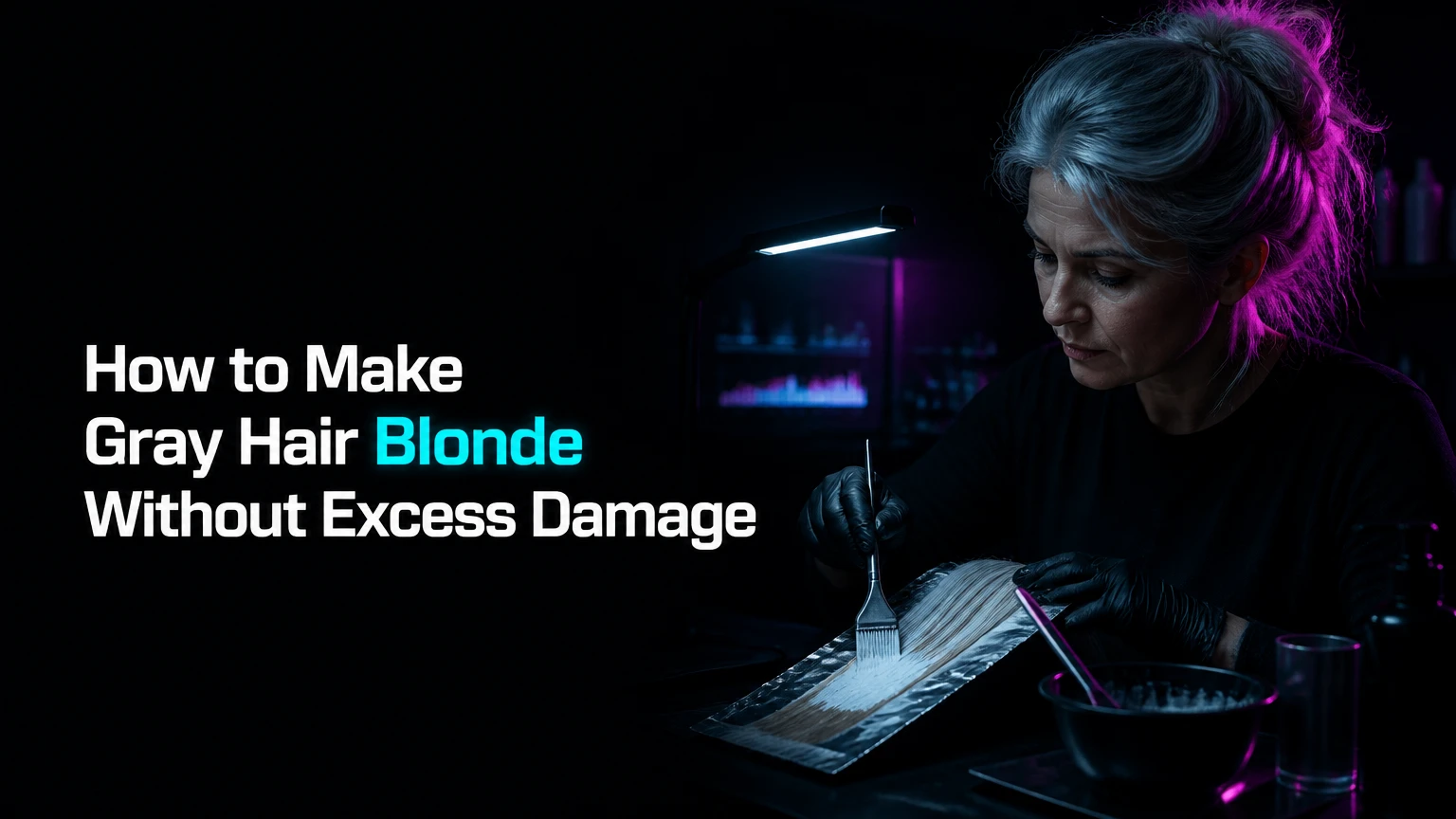
To make gray hair blonde, first determine whether the hair is natural gray, white, or previously colored. Natural white hair may need only a blonde toner or demi-permanent gloss, while darker salt-and-pepper hair usually needs controlled lightening. Highlights or gray blending often create a softer grow-out than bleaching the entire head.
Key Facts
Natural white hair contains little or no melanin, so bleach may add damage without creating meaningful lift.
Hair color cannot reliably lighten previously applied permanent color; dark dyed lengths often require correction.
A strand test predicts lift, porosity, and final tone better than a processing-time guess.
Purple shampoo neutralizes excessive yellow, but it cannot repair chemically weakened hair.
A professional is the safest choice for dark dyed hair, overlapping bleach, scalp irritation, or severe breakage.
Electrolysis removes individual hairs from follicles; it does not turn gray scalp hair blonde.
Can Gray Hair Become Blonde?
Yes, gray hair can become blonde, but the correct method depends on how much natural pigment remains and whether the hair contains artificial dye. White hair may be toned directly, whereas salt-and-pepper hair usually needs selective lightening to make darker strands blend with the gray.
Gray hair is not one uniform material. A head with 20 percent gray still contains substantial brown or black pigment, while 100 percent white hair may have almost no visible melanin. Gray hair can also be coarser, more resistant at the cuticle, and less predictable in its absorption of color.
The practical goal matters. All-over blonde aims for a relatively even color. Gray blending aims to reduce contrast between dark regrowth and silver strands. A beige or champagne blonde can look softer than an icy ash shade when the natural gray is warm or uneven.
What is the difference between gray, silver, and white hair?
Gray hair is a mixture of pigmented and unpigmented strands. Silver hair usually describes a cool, reflective gray appearance, while white hair has little visible pigment and often appears brighter. The distinctions are visual rather than strict laboratory categories.
| Starting hair | Remaining pigment | Usually required | Main risk |
|---|---|---|---|
| 10-30% gray | High | Partial highlights | Orange or red exposed pigment |
| 40-70% salt-and-pepper | Moderate | Highlights or controlled global lift | Uneven lightness |
| 80-99% gray | Low | Toner, gloss, or selective lift | Porosity and dullness |
| 100% white | Minimal | Demi gloss or low-volume toner | Violet, blue, or hollow tone |
When Is Bleach Necessary for Gray Blonde Hair?
Bleach is necessary when darker strands must become significantly lighter, but bleach is often unnecessary for naturally white hair. A toner deposits or adjusts tone; it does not remove enough natural or artificial pigment to transform dark brown hair into pale blonde.
Hair lightener uses alkaline ingredients and an oxidizing developer to break down natural pigment. Dark hair generally passes through red, orange, and yellow stages before reaching blonde. The lighter the target, the more completely the underlying warm pigment must be controlled.
A key correction to the common DIY advice is that a high-lift blonde box dye cannot reliably lighten previously dyed dark hair. Permanent color generally does not lift permanent color. A corrective service may require color removal, lightener, multiple sessions, and bond-protection measures.
How do you know whether to lighten or tone?
Use the following decision rule: tone naturally white hair, highlight darker gray hair, and consult a colorist before lightening previously dyed dark lengths. A strand test should confirm the choice before the whole head is treated.
| Desired result | Natural white hair | Salt-and-pepper hair | Previously dark dyed hair |
|---|---|---|---|
| Beige blonde | Demi gloss, level 9-10 | Fine beige highlights | Corrective lightening |
| Cool blonde | Violet or pearl toner | Ash or pearl foils | Professional color correction |
| Golden blonde | Gold-beige gloss | Warm face-framing highlights | Controlled lift and toner |
| Uniform pale blonde | Low-volume tint may work | Global lightening may be needed | Usually multiple sessions |
Which Technique Works Best?
Highlights are usually the safest visual transition for salt-and-pepper hair, while a gloss is the least damaging choice for naturally white hair. Global blonde creates the most uniform result but produces the strongest root contrast and demands the most maintenance.
Herringbone or gray-blending highlights alternate cool and warm strands through the existing gray pattern. The irregular placement prevents a hard stripe and preserves dimension. Balayage creates a soft gradient, but it may leave dark areas if the goal is a uniformly blonde head.
Balayage is not automatically unsuitable for predominantly white hair. It is simply less useful when the client wants every strand to match, because hand-painted lightener does not saturate each strand equally.
| Method | Best starting point | Typical appointment | Typical maintenance | Root effect |
|---|---|---|---|---|
| Global blonde | 70-100% gray with healthy hair | 3-5 hours | 4-8 weeks | Defined root line |
| Fine highlights | 30-80% salt-and-pepper | 2.5-4 hours | 8-14 weeks | Diffused regrowth |
| Herringbone foils | Uneven natural gray | 3-5 hours | 10-16 weeks | Low-contrast grow-out |
| Gray-blonde balayage | Darker mids and lighter ends | 3-4.5 hours | 12-24 weeks | Soft gradient |
| Demi gloss | 80-100% white hair | 45-90 minutes | 4-8 weeks | Minimal line |
Why do gray-blending highlights often outperform all-over blonde?
Gray-blending highlights preserve some natural variation, so new gray roots do not form a single high-contrast band. The technique also limits lightener to selected strands, which can reduce cumulative damage compared with repeatedly bleaching every length.
The trade-off is incomplete coverage. Highlights do not make every gray or dark strand blonde. They are a poor choice for someone who wants a solid platinum canvas, and they require accurate sectioning to avoid visible bands.
How to Make Gray Hair Blonde at Home
A cautious home process takes approximately 2-4 hours, including allergy testing, strand testing, application, rinsing, toning, and conditioning. The success factor is controlled lift with no overlap onto already lightened hair, not a stronger developer or a longer processing time.
Before You Start
| Requirement | Typical specification | Why it matters |
|---|---|---|
| Product quantity | 1 kit for short hair, 2 kits for shoulder-length hair | Prevents uneven saturation |
| Developer | 10-volume toner developer, 20-volume lightener developer when permitted | Limits unnecessary alkalinity |
| Processing | Follow the package, often 20-45 minutes | Prevents overprocessing |
| Tools | Nonmetal bowl, tint brush, clips, gloves, timer | Improves controlled placement |
| Testing | Allergy test 48 hours before, strand test before application | Identifies reaction and breakage risk |
| Hair condition | No active scalp irritation or gummy elasticity | Damaged hair may not tolerate lightener |
Do not apply lightener immediately after scratching the scalp, using harsh exfoliants, or washing aggressively. Avoid metal bowls unless the product instructions specifically allow them, because some formulas can react with metal contamination.
Step 1: Test the Product and the Hair
Perform the manufacturer’s allergy alert or patch test 48 hours before coloring, exactly as the product label directs. Perform a separate strand test on hidden hair by applying the planned lightener and toner, then check the strand for lift, elasticity, porosity, and final color.
The U.S. Food and Drug Administration advises, “Never leave the product on longer than the directions say.” The FDA also recommends following package precautions and stopping when irritation develops. A patch test does not guarantee that a reaction cannot occur, but skipping it removes an important warning system.
Success checkpoint: The test strand reaches the intended level without snapping or stretching excessively.
Common mistake: Testing only the color and ignoring the strand’s strength after rinsing.
Step 2: Section the Hair and Protect the Hairline
Work on dry hair unless the product instructions specify another condition. Divide the head into four quadrants, clip each section securely, and apply a thin layer of petroleum jelly around the hairline without coating the hair itself.
Use smaller subsections for coarse, dense, or highly uneven hair. Keep the product off the ears, eyes, broken skin, and clothing. Wear gloves throughout the process, including during rinsing if the product instructions require them.
Success checkpoint: Every planned section is visible, and the scalp remains free of unnecessary product.
Common mistake: Making large sections that hide dry patches beneath saturated outer hair.
Step 3: Apply Lightener to Darker Mid-Lengths
Mix bleach powder and developer only according to the manufacturer’s ratio. A common professional formula uses a 1:2 powder-to-developer ratio, but product formulas differ, so the label overrides a generic ratio.
Apply lightener first to the darkest resistant areas and keep approximately 1 inch away from the scalp at the beginning. Mid-lengths may require more time than roots because scalp heat accelerates processing near the skin.
Do not drag fresh lightener over previously lightened blonde ends. Saturate each strand evenly, but avoid massaging product into the scalp.
Success checkpoint: The strand moves from its starting level toward the target without severe patchiness.
Common mistake: Applying more product to pale ends because they look dry, which can cause breakage rather than improved color.
Step 4: Apply Lightener to the Roots Last
Apply lightener to the natural root area only after the darker mid-lengths have begun to lift, unless the professional product instructions specify another order. Scalp warmth often makes roots process faster than cool lengths.
Avoid applying lightener directly over fragile white or previously bleached hair. A professional may use different formulas on resistant roots, porous ends, and gray-blending sections, which is one reason a single all-over mixture can produce uneven results.
Success checkpoint: The roots approach the same underlying level as the mids without scalp burning or swelling.
Common mistake: Increasing developer strength to force resistant gray hair lighter.
Step 5: Rinse at the Correct Endpoint
Check the hair at the minimum time stated on the product label and reassess at the permitted intervals. Stop when the hair reaches the required underlying level, or rinse immediately if the scalp burns, the hair becomes gummy, or the product contacts the eyes.
Rinse with lukewarm water until no lightener remains. Use the cleanser or pH-balancing shampoo recommended by the product system, then gently blot rather than rough-drying the hair.
Success checkpoint: The hair feels wet and flexible, not stretchy, mushy, or unusually fragile.
Common mistake: Leaving lightener on for 30-45 minutes automatically even when the strand has already reached its endpoint.
Step 6: Tone the Hair Blonde
Apply toner to clean, damp hair only if the toner instructions permit that condition. Use a toner matched to the exposed level: violet or pearl helps counter yellow, while beige or gold can prevent an overly gray, hollow result.
Toner deposits color; it does not repair damage or create several levels of additional lift. A typical toner uses 10-volume developer, but the manufacturer’s instructions control the ratio and timing.
Success checkpoint: The tone looks even under natural light after rinsing and drying.
Common mistake: Choosing an intense ash toner for pale, porous hair, which can create a dull blue-violet or gray cast.
Step 7: Condition and Record the Formula
Apply a bond-supporting or conditioning treatment compatible with the color system. Record the lightener, developer strength, toner shade, mixing ratio, processing time, and the areas treated.
Hair color records prevent repeated guesswork at the next appointment. They also reveal whether yellowing came from toner fade, mineral deposits, heat exposure, or insufficient underlying lift.
Success checkpoint: The hair has normal wet elasticity and does not feel gummy when gently stretched.
Common mistake: Treating a bond-building mask as permission to bleach again immediately.
Which Developer Strength Is Safest?
For many controlled lightening services, 20-volume developer offers a practical balance between lift and scalp tolerance, while 10-volume developer is commonly used for deposit-only toning. Thirty-volume may be appropriate for selected professional applications, but 40-volume creates unnecessary risk for most home users.
Developer strength is not a universal speed setting. Higher peroxide concentration can increase swelling, irritation, dryness, and breakage, particularly on porous or previously processed hair.
| Developer | Typical role | Approximate lift context | Home-use concern |
|---|---|---|---|
| 5-volume | Deposit, refresh, acidic systems | 0 levels | Limited lift |
| 10-volume | Toner or deposit color | 0-1 level | Still requires label compliance |
| 20-volume | Controlled lightening or gray coverage | 1-2 levels | Overlap can weaken hair |
| 30-volume | Selected professional lightening | 2-3 levels | Greater irritation and dryness |
| 40-volume | Specialized professional use | Product-dependent | High burn and breakage risk |
Never combine products from incompatible systems. A salon professional may use bond protectors, low-alkaline lighteners, or different developers by section, but those decisions depend on the hair’s history and the product chemistry.
What Blonde Shade Suits Gray Hair?
Beige, pearl, champagne, ash, and soft gold can all suit gray hair; the best shade depends on skin undertone, existing gray temperature, and the exposed yellow level. Neutral beige is often the most forgiving choice because it balances excessive warmth without making porous hair look blue.
Ash shades reduce orange and yellow but can appear dull on highly porous white hair. Golden shades add light and softness but may emphasize yellow if the hair is already warm. Pearl or violet shades work best when the underlying hair is pale yellow and evenly lightened.
| Blonde tone | Best underlying level | Visual result | Main risk |
|---|---|---|---|
| Ash blonde | 8-10 | Smoky, cool finish | Green-gray or dull cast |
| Pearl blonde | 9-10 | Reflective cool finish | Violet overdeposit |
| Beige blonde | 8-10 | Neutral, soft finish | Warmth if underlifted |
| Champagne blonde | 8-10 | Creamy, luminous finish | Yellow emphasis |
| Golden blonde | 7-9 | Warm, bright finish | Brassy appearance |
How Much Time and Money Does Gray Blonde Color Take?
A salon gray-to-blonde service typically takes 2.5-5 hours and costs about $150-$500 in the United States, with corrective work potentially exceeding $600. Home materials commonly cost $25-$100, but repeated failed applications can cost more than an initial consultation.
Prices vary by city, hair density, length, correction history, stylist level, and whether a haircut or bond treatment is included. The figures below are typical planning ranges, not universal prices.
| Service | Typical time | Typical U.S. price | Maintenance interval |
|---|---|---|---|
| Toner or gloss | 45-90 minutes | $50-$150 | 4-8 weeks |
| Partial highlights | 2-3.5 hours | $120-$300 | 8-14 weeks |
| Full highlights | 3-5 hours | $180-$450 | 10-16 weeks |
| Global blonde | 3-5 hours | $200-$500 | 4-8 weeks |
| Color correction | 4-8 hours | $300-$800+ | Case-dependent |
International pricing can differ substantially. A quoted price in Bangladesh, the United Kingdom, Australia, or the United States should be compared by included services rather than converted currency alone.
How Should Different Gray Patterns Be Handled?
People with 100 percent white hair usually need a gloss or toner strategy, while salt-and-pepper hair often benefits from fine highlights that target the darker strands. Damaged hair should not be lightened until elasticity and breakage have been assessed.
For 100 percent white hair
Start with a strand test using a demi-permanent beige, pearl, or soft ash gloss. Direct bleaching may increase porosity while producing little visible improvement because the hair has minimal melanin to remove.
For salt-and-pepper hair
Use fine highlights, herringbone foils, or carefully placed lowlights. The objective is to reduce the visual contrast between dark strands and gray, not necessarily to make every strand pale blonde.
For previously dyed dark hair
Do not apply blonde box dye over dark permanent color and expect reliable lift. Arrange a consultation for color history, test strands, possible color removal, and a staged lightening plan.
For fragile or textured hair
Curly, coily, fine, and highly porous hair can lose moisture and tensile strength quickly. Use smaller test sections, avoid overlapping lightener, reduce heat styling, and allow longer recovery intervals between chemical services.
What Problems Can Occur?
Yellow, orange, uneven, green, and gummy results have different causes, so one corrective product cannot solve every failure. Identify the underlying level and hair condition before applying more color or lightener.
| Problem | Likely cause | Immediate action | Avoid |
|---|---|---|---|
| Bright yellow | Pale yellow undertone or faded toner | Use a correctly matched violet or pearl toner | Rebleaching healthy pale hair |
| Orange bands | Insufficient lift or uneven saturation | Consult a colorist for targeted correction | Applying ash blindly |
| Green cast | Chlorine, minerals, or excessive ash | Use a chelating treatment or warm corrective gloss | Repeated purple shampoo |
| Gummy texture | Overprocessing and weakened keratin structure | Stop chemicals and seek professional assessment | Brushing wet hair aggressively |
| Dark spots | Poor saturation or resistant sections | Correct only the dark areas | Overlapping lightener everywhere |
| Purple-gray cast | Too much cool pigment on porous hair | Use a clarifying wash if appropriate | Adding more ash toner |
Purple shampoo is appropriate for mild yellowing, not for orange hair, green deposits, or structural damage. Use it according to the label, often once weekly, because porous white hair can absorb violet pigment quickly.
Mineral buildup from hard water or chlorine can make blonde hair yellow, green, or dull. A chelating shampoo may help remove deposits, but severe discoloration may require a salon color correction.
What Are the Most Common Mistakes?
The most damaging mistake is overlapping lightener onto hair that has already been lightened. The most common color mistake is selecting toner by the desired name rather than the actual underlying level, and the most common safety mistake is ignoring a burning scalp or failed strand test.
- Using 40-volume developer at home: Higher strength does not guarantee an even blonde result and can increase irritation and breakage.
- Treating white hair like dark hair: White hair often needs tone adjustment, not pigment removal.
- Applying permanent blonde over dark dye: Color generally cannot lift artificial color predictably.
- Toning orange hair with violet alone: Violet controls yellow; blue-based formulas may be needed for orange, depending on the level.
- Rebleaching gummy hair: Elastic, stretchy hair needs chemical rest and assessment.
- Skipping mineral removal: Deposits can distort blonde tone and interfere with even color.
Can Electrolysis Make Gray Hair Blonde?
Electrolysis cannot make gray scalp hair blonde because electrolysis destroys individual hair follicles rather than changing the pigment inside a growing hair shaft. Electrolysis is a permanent hair-removal method used on unwanted facial or body hair, not a color service for the hair on the scalp.
Gray and white hairs can be difficult for some laser hair-removal systems because they contain little melanin, while electrolysis does not depend on hair pigment in the same way. That distinction concerns removal, not blonde coloring.
For scalp hair, use a toner, gloss, highlights, or lightener selected for the hair’s pigment and condition. Do not use an electrolysis device or hair-removal treatment as a substitute for cosmetic color.
How Do You Maintain Blonde Gray Hair?
Maintain blonde gray hair with root planning, occasional toning, gentle cleansing, and mineral control rather than frequent full-head bleaching. Most people refresh a toner every 4-8 weeks, while gray-blending highlights may last 8-16 weeks before a salon visit.
Use a color-safe shampoo, conditioner, heat protectant, and periodic conditioning treatment. Purple shampoo is a targeted correction product, not a daily cleanser for every blonde head. Excessive use can create violet buildup and leave porous hair dull.
| Maintenance task | Typical frequency | Product or service | Purpose |
|---|---|---|---|
| Gentle shampooing | 2-4 times weekly | Color-safe cleanser | Reduce dryness and fade |
| Purple shampoo | Every 7-14 days | Violet pigment cleanser | Reduce mild yellow |
| Toner or gloss | 4-8 weeks | Demi-permanent formula | Refresh blonde tone |
| Chelating wash | Every 4-8 weeks if needed | Mineral-removing cleanser | Remove hard-water deposits |
| Highlight retouch | 8-16 weeks | Partial or full foils | Blend darker regrowth |
| Heat protection | Every heat session | Thermal protectant | Reduce thermal stress |
A low-maintenance plan usually combines a natural gray root with beige or pearl highlights rather than chasing an unbroken platinum result. That choice reduces the frequency of overlapping chemical work.
Frequently Asked Questions
Can I use blonde box dye on gray hair?
Blonde box dye may deposit a warm or neutral tone on naturally white or very light gray hair, but it will not reliably lighten dark gray strands or previously dyed hair. Check the product’s intended level range, perform an allergy test, and use a strand test before applying the formula broadly.
How long should bleach stay on gray hair?
Bleach should remain on gray hair only for the time stated by the specific product, commonly within a 20-45-minute range. Gray hair may be resistant, but resistance does not justify exceeding the label time. Rinse early if the scalp burns or the hair becomes stretchy.
Will toner cover gray roots?
Toner can tint white or very light gray roots, but most toners do not provide opaque coverage of darker gray or regrowth. For solid gray coverage, a permanent color or a professional gray-coverage formula may be required, although that creates a more noticeable regrowth line.
Why does my gray hair turn yellow after bleaching?
Gray or white hair can turn yellow because of natural underlying warmth, toner fade, heat, smoking, hard-water minerals, chlorine, or product buildup. Mild yellowing may respond to a violet shampoo or toner, while mineral-related yellow or green requires chelation before recoloring.
Is blonde hair lower maintenance than gray hair?
Blonde hair is lower maintenance only when the shade is close to the natural gray pattern. Global blonde creates visible roots in roughly 4-8 weeks, while highlights or gray blending can often last 8-16 weeks because the grow-out is diffused.
Should I bleach gray hair if it feels coarse?
Coarseness alone does not prove that gray hair is too fragile for lightening, but it warrants a strand test and professional assessment. Check wet elasticity, previous chemical history, and porosity. If hair stretches, snaps, or feels gummy, postpone lightening and focus on conditioning and repair.
The Bottom Line
To make gray hair blonde, match the technique to the pigment: tone naturally white hair, use highlights for salt-and-pepper blending, and reserve global bleaching or corrective lightening for healthy hair with a clear plan. A strand test, conservative developer choice, accurate toner, and no overlap matter more than processing for a fixed number of minutes.
The safest answer to how to make gray hair blonde is not always “bleach the whole head.” For many people, pearl or beige gloss with strategically placed highlights creates a softer, healthier, and less demanding result than uniform platinum.