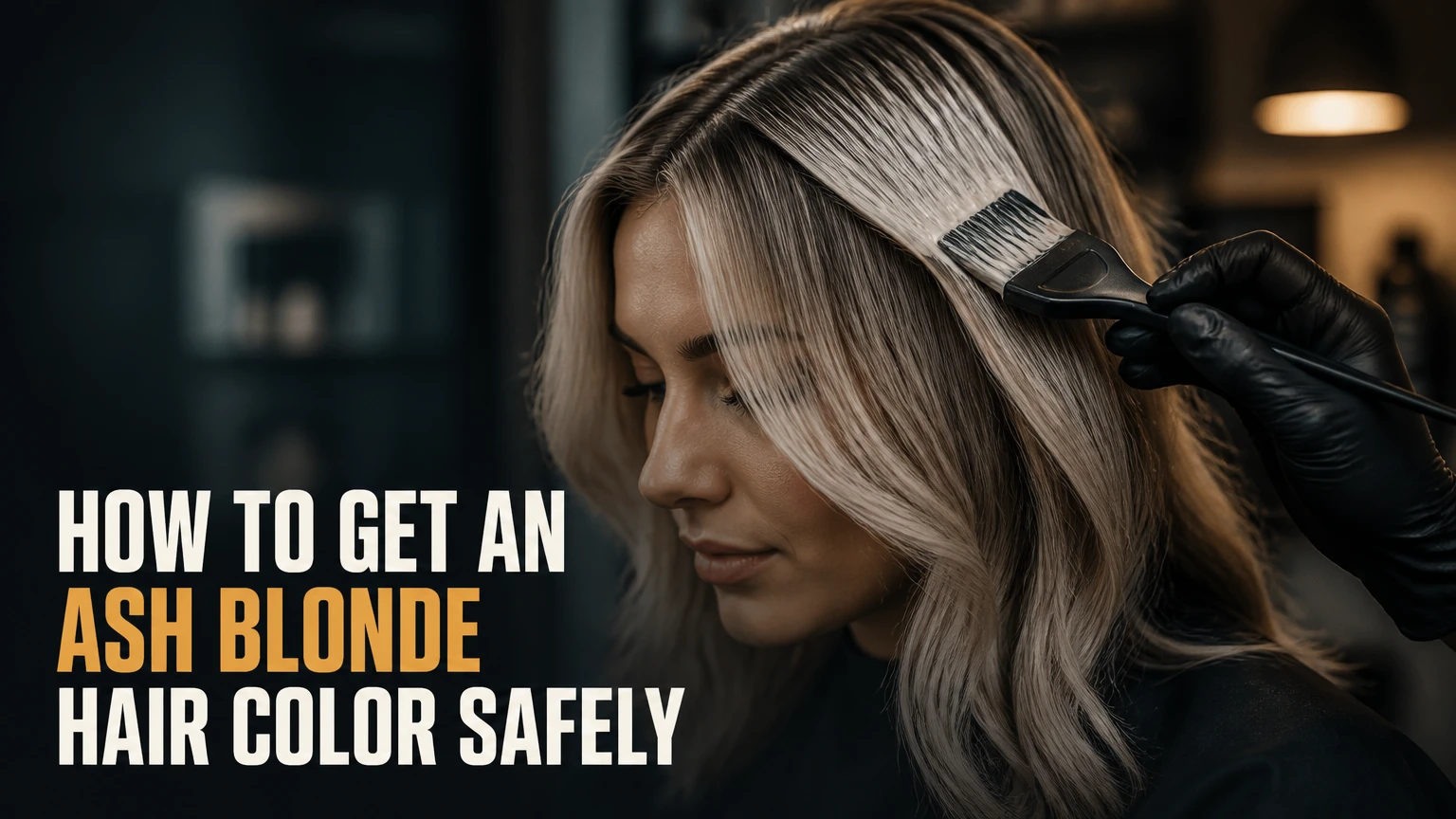
To get an ash blonde hair color, first lighten the hair to a pale yellow level 9 or 10, then neutralize the remaining yellow with a violet- or blue-violet-based toner selected for the actual underlying warmth. Hair condition, previous dye, starting depth, and evenness determine whether the result takes one session or several.
Key Facts at a Glance
- True ash blonde is a cool blonde with gray, smoky, violet, or blue-green visual undertones and minimal gold.
- Bleach removes natural or artificial pigment; toner deposits tone but does not make dark orange hair blonde.
- Most pale ash blonde results require a level 9 or 10 canvas, not merely a light brown or orange base.
- Violet controls yellow; blue controls orange, but excessive blue on yellow hair can create a green cast.
- Global ash blonde root retouches typically occur every 4-6 weeks, while balayage may last 3-6 months.
- Fragile, stretchy, previously lightened, or box-dyed hair should receive a professional color assessment before bleaching.
What Does Ash Blonde Hair Color Look Like?
Ash blonde is a cool-toned blonde whose visible tone comes from gray, violet, blue, or muted green pigments rather than gold, copper, or honey. The shade can range from a soft dark ash blonde around level 7 to an icy pale ash blonde around level 10.
Ash blonde is not automatically gray hair, platinum hair, or silver hair. Platinum describes exceptional lightness, while ash describes temperature. A level 9 blonde can be ash, beige, or golden depending on the toner, and a level 10 blonde can still look warm if it contains yellow or gold pigment.
| Shade | Typical depth | Visible undertone | Best description |
|---|---|---|---|
| Dark ash blonde | Level 7 | Smoky beige, muted green-gray | Natural-looking cool blonde |
| Medium ash blonde | Level 8 | Blue-violet, soft gray | Balanced cool blonde |
| Light ash blonde | Level 9 | Pale violet, silver-beige | Bright cool blonde |
| Icy ash blonde | Level 10 | Silver, violet, nearly white | High-maintenance pale blonde |
Hair colorists use level to describe depth and tone to describe reflect. The distinction matters because choosing a level 10 ash toner cannot turn level 7 orange hair into level 10 blonde. The hair must first reach the required depth.
How Light Must Hair Be for Ash Blonde?
Ash blonde usually requires a level 9 or 10 base for a light, clean result, although darker ash blondes can be created on levels 7 and 8. The correct target is pale yellow for icy ash, yellow for light ash, and yellow-orange for some darker smoky blondes.
The underlying pigment becomes progressively warmer as hair lightens. Hair commonly moves from black or dark brown through red, red-orange, orange, yellow-orange, yellow, and pale yellow. Lifting exposes those pigments rather than removing all color in one uniform action.
| Starting level | Common exposed warmth | Realistic ash result | Typical pathway |
|---|---|---|---|
| Level 1-3 black or dark brown | Red to red-orange | Ash balayage or staged blonde | 2-4 salon sessions |
| Level 4-5 medium brown | Orange to yellow-orange | Dimensional ash blonde | 1-3 sessions |
| Level 6 light brown | Yellow-orange to yellow | Medium or light ash blonde | 1-2 sessions |
| Level 7-8 dark blonde | Yellow to pale yellow | Light ash blonde | Often 1 session |
| Level 9-10 light blonde | Pale yellow | Toner or gloss refresh | Usually no bleach |
Color theory explains the neutralization step. Violet sits opposite yellow on the color wheel, while blue helps counter orange. Toner selection should follow the color visible after lifting, not the color shown on a box.
Why Can’t Toner Replace Bleach?
Toner cannot replace bleach because toner deposits or adjusts color without removing enough dark melanin to create a pale blonde base. Applying an ash toner to level 7 orange hair may make the result look dull, khaki, or brown, but it will not produce a clean level 9 blonde.
High-lift permanent color can lighten some virgin dark blonde or light brown hair, but it does not reliably lift previously colored hair. A strand test is the only dependable way to assess the actual result.
Before You Start
Complete a consultation, allergy test, strand test, and hair-condition assessment before applying lightener. A practical home setup requires 2-4 hours, disposable gloves, sectioning clips, a tint brush, nonmetal bowl, scale, lightener, the manufacturer-specified developer, toner, timer, bond-support product, and a color-safe conditioner.
| Preparation factor | Typical requirement | Decision rule |
|---|---|---|
| Hair assessment | 5-10 minutes | Stop if wet hair stretches excessively |
| Allergy or patch test | Product instructions, often 48 hours | Follow the product label exactly |
| Strand test | 1 hidden section, 20-45 minutes | Continue only if lift and integrity are acceptable |
| Hair washing | Clean, dry, detangled hair | Avoid aggressive scalp scrubbing before bleach |
| Product quantity | 30-120 g lightener, depending on density | Prepare enough for complete saturation |
The instruction to leave hair dirty for 48 hours is not universal. Natural oils may reduce scalp discomfort, but oil, dry shampoo, mineral buildup, and styling residue can also interfere with even application. Follow the lightener manufacturer’s instructions and avoid bleaching an irritated or scratched scalp.
Do not bleach hair that has unknown black box dye, metallic dye, henna containing metallic salts, or repeated overlapping permanent color without professional testing. Chemical history often matters more than natural hair color.
How to Get an Ash Blonde Hair Color Step by Step
The safest process has six stages: assess, prepare, lift, rinse, tone, and condition. Application accuracy matters more than using a stronger developer because uneven saturation creates bands that toner cannot hide.
Step 1: Assess the Hair and Choose the Target
Identify the natural level, artificial color, porosity, texture, density, and previous chemical services. Decide whether the goal is all-over ash blonde, highlights, balayage, a shadow root, or a darker ash gloss.
Perform a strand test on hair containing the most color or damage. Record the starting time, mixture, lift level, elasticity, and final tone. If the strand becomes gummy, snaps, or fails to lighten evenly, do not proceed with a full application.
You will know this step worked when: the target shade and realistic session count are clear.
Common mistake: treating dyed hair as if it were virgin hair.
Step 2: Protect the Scalp, Skin, and Workspace
Wear gloves, protect clothing, and use ventilation. Keep lightener away from eyes, lips, broken skin, and the neck. Do not use metal bowls or tools if the product instructions prohibit them.
Divide dense hair into four or more sections. Have a timer, water source, and cleanup materials ready before mixing, because lightener begins working immediately after activation.
You will know this step worked when: every section is cleanly separated and all supplies are within reach.
Common mistake: mixing product before sectioning, which causes slow and uneven application.
Step 3: Apply Lightener to the Darkest Areas First
Mix lightener and developer only according to the brand’s instructions. A 1:2 ratio is common for some powder lighteners, but it is not a universal rule, and developer strength should not be chosen solely from hair coarseness.
Apply to resistant mid-lengths first when the roots are virgin and scalp heat will accelerate processing. Avoid overlapping previously lightened ends. Apply the root area later when appropriate, but follow the product’s timing and application directions.
Check the hair every 5-10 minutes. Never exceed the printed maximum processing time, and do not add heat unless the manufacturer specifically allows it.
You will know this step worked when: the hair reaches the intended yellow or pale-yellow stage with consistent saturation.
Common mistake: applying extra developer or leaving bleach longer to force lift after the product has stopped working.
Step 4: Rinse When the Hair Reaches the Correct Level
Rinse thoroughly with lukewarm water when the strand test and visual checks show the required lift. Remove all lightener, then cleanse according to the product directions. A gentle post-bleach cleanser is usually preferable to aggressive clarifying shampoo on fragile hair.
Do not tone hair that is still orange when the desired shade requires pale yellow. Do not automatically bleach again on the same day, because the hair may need time to recover and the scalp may be sensitized.
You will know this step worked when: no slippery lightener remains and the hair feels wet but structurally intact.
Common mistake: judging color while hair is coated with residual lightener or conditioner.
Step 5: Select and Apply the Toner
Choose toner by the exposed pigment. Violet or violet-blue formulas suit pale yellow to yellow hair, while a controlled blue-violet formula may help yellow-orange hair if the desired result is darker and smoky. Pure blue on yellow hair can create green.
Apply toner evenly to clean, damp or dry hair as directed by the manufacturer. Saturate porous ends carefully because they can absorb cool pigment faster than resistant roots. Watch the color visually rather than relying only on the maximum development time.
You will know this step worked when: yellow or gold is softened without gray, green, or muddy patches.
Common mistake: using a strong ash formula on porous, nearly white ends for the full processing time.
Step 6: Rinse, Condition, and Document the Formula
Rinse once the unwanted warmth has been neutralized. Use the toner brand’s recommended rinse method, then apply a conditioning treatment designed for chemically processed hair. Record the toner shade, developer, mixing ratio, timing, and areas that processed quickly.
Ash pigment fades because washing, heat, sun, porosity, and mineral deposits gradually remove or obscure the deposited tone. Formula notes make future salon or home gloss appointments more predictable.
You will know this step worked when: the final tone is even in natural light and the hair remains elastic rather than stretchy.
Common mistake: immediately applying repeated purple products because the first result looks slightly warmer indoors.
Which Ash Blonde Technique Fits Your Goal?
Global bleach creates the brightest root-to-tip result, while balayage, highlights, and a shadow root reduce regrowth contrast and chemical exposure. The best technique depends on brightness, maintenance tolerance, starting color, and the amount of previously processed hair.
| Technique | Brightness | Root upkeep | Typical appointment interval | Best use |
|---|---|---|---|---|
| Global bleach and tone | Level 9-10 all over | 4-6 weeks | 4-6 weeks | Maximum uniform brightness |
| Full highlights | High dimension | 8-12 weeks | 2-3 months | Brightness with natural lowlights |
| Ash balayage | Medium-high ends | 12-24 weeks | 3-6 months | Soft grow-out and darker roots |
| Shadow-root ash blonde | Bright lengths, darker root | 8-16 weeks | 2-4 months | Lower-maintenance blonding |
A shadow root is not maintenance-free. The root blend still needs refreshing, and porous lengths may need a separate gloss. Balayage also takes longer to build on dark hair because the stylist must preserve enough untreated hair to maintain dimension.
Ash Blonde Versus Similar Cool Shades
Ash blonde is the best choice when the goal is muted, smoky, or gray-beige blonde rather than warmth. Beige blonde contains a controlled balance of warm and cool tones, while platinum describes lightness and silver emphasizes a gray metallic effect.
| Shade | Main pigment impression | Warmth level | Maintenance concern |
|---|---|---|---|
| Ash blonde | Violet, blue, gray | Low | Can look dull if over-toned |
| Beige blonde | Gold plus violet balance | Low-medium | Needs balanced glossing |
| Platinum blonde | Very pale neutral or cool | Low | High root and damage upkeep |
| Silver blonde | Gray, violet, metallic | Very low | Shows yellow quickly |
Ash blonde is not ideal for every objective. It is a poor choice if you want honey, caramel, golden, or sunlit blonde, and it can make some very porous hair look flat when too much blue-violet pigment accumulates.
What Does Ash Blonde Cost and How Long Does It Take?
A professional ash blonde appointment commonly takes 3-6 hours and costs approximately $150-$400 or more in many markets; home products commonly cost $20-$60 before tools and corrective services. Dark hair, box dye, high density, multiple sessions, and metropolitan salon pricing can increase both figures.
These are typical ranges, not universal prices. A salon should quote separately for lightening, toner or gloss, bond treatment, haircut, and future root maintenance.
| Service or situation | Typical time | Typical cost in USD | Likely sessions |
|---|---|---|---|
| Virgin level 7-8 to ash blonde | 2.5-4 hours | $120-$250 | 1 |
| Dark virgin level 1-5 to dimensional ash | 4-6 hours | $200-$450 | 2-4 |
| Box-dyed brunette correction | 4-8 hours per visit | $250-$600+ | 2-5 |
| Home lightener and toner | 2-4 hours | $20-$60 | 1-3 |
| Root retouch and toner | 2-3 hours | $100-$250 | Every 4-6 weeks |
Is Salon Blonding Safer Than DIY?
Salon blonding is safer when hair is dark, chemically treated, unevenly colored, fragile, curly, or difficult to section. DIY can be reasonable for experienced users with healthy, virgin level 7-9 hair who can perform strand and allergy tests and follow the product instructions exactly.
A salon cannot eliminate chemical risk, but a skilled colorist can adjust formulas by zone, avoid overlapping lightener, identify banding, and stop when elasticity declines. The strongest home advantage is cost, not control.
How Do You Maintain Cool Blonde Hair?
Wash ash blonde hair less frequently when possible, use lukewarm water, apply heat protection, and alternate a regular color-safe cleanser with a violet shampoo only when yellow appears. A demi-permanent gloss or toner refresh usually lasts about 2-6 weeks, depending on porosity and washing frequency.
| Maintenance action | Typical frequency | Purpose | Warning |
|---|---|---|---|
| Color-safe shampoo | 1-3 washes weekly | Reduce pigment loss | Daily washing fades toner faster |
| Violet shampoo | Every 1-2 weeks | Reduce yellow | Overuse can make hair dull or violet |
| Deep conditioning mask | Weekly | Improve softness and manageability | Moisture does not repair broken bonds |
| Toner or gloss | 2-6 weeks | Restore cool tone | Match formula to current warmth |
| Root lightening | 4-8 weeks | Maintain global blonde | Do not overlap onto lightened hair |
Hard water can leave mineral deposits that make blonde appear dull, yellow, or greenish. A chelating treatment may help, but it should be used according to its instructions because repeated aggressive cleansing can increase dryness.
Common Mistakes and How to Fix Them
Orange Hair After Bleaching
Orange hair means the hair has not reached the pale base required for a light ash blonde result. Do not cover it with a pale ash toner and expect it to become lighter.
Stop, condition gently, and reassess elasticity. A second lightening session may be appropriate after recovery, but a professional should decide the timing when the first session produced uneven bands, scalp irritation, or significant dryness.
Green Hair After Toning
Green hair usually results from excess blue pigment interacting with yellow underlying pigment or mineral buildup. Stop blue and ash products, wash with a gentle clarifying or chelating product when appropriate, and seek a colorist if the cast persists.
A controlled warm corrective gloss may neutralize green, but home application is risky on porous hair because a small amount of red or pink can overcorrect quickly.
Muddy Gray or Khaki Hair
Muddy hair often results from applying too much cool pigment to an under-lifted or highly porous base. It can also occur when a blue-based formula is used where violet was needed.
Pause toning products and wash normally for several sessions. A professional may use a gentle warm fill before applying a new ash formula, especially if the hair has uneven porosity.
Gummy, Stretchy, or Snapping Hair
Gummy hair is a stop signal, not a toner problem. Avoid bleach, permanent color, high heat, tight hairstyles, and aggressive brushing until a professional evaluates the hair.
Conditioning can improve feel, but no mask can restore hair that has lost structural integrity. Bond-support products may assist care, yet they do not make another bleach session safe immediately.
Uneven Bands
Bands occur when different sections contain different pigment histories, application timing, saturation, or porosity. Do not apply one formula over the entire head without mapping the zones.
A colorist may use separate lightener strengths, a targeted correction, lowlights, or a shadow root to disguise the difference while protecting the most fragile lengths.
Which Starting Situation Needs a Different Plan?
Dark natural hair usually benefits from ash balayage, foilyage, or fine highlights over multiple appointments. Global bleaching from level 1-5 creates the greatest contrast at the roots and carries the highest overlap risk.
Natural level 7-9 hair may reach ash blonde in one salon session if it is healthy and free from artificial pigment. High-lift color can sometimes lighten virgin hair, but it cannot reliably remove old dye and may leave warmth that still needs toning.
Curly, fine, or highly porous hair needs smaller test sections and conservative processing. Curl pattern, elasticity, and surface condition can change after lightening even when the final color looks even.
What About Gray Hair?
Gray hair can blend well with ash blonde, but gray strands may have less underlying warmth and can absorb violet or blue toner strongly. A translucent demi-permanent gloss often creates a softer result than an opaque permanent ash color.
A stylist should evaluate the ratio of gray to pigmented hair, because one formula may look silver on gray strands and darker ash on the remaining natural hair.
Does Hair Electrolysis Change Hair Color?
Hair electrolysis does not create, remove, or tone blonde pigment. Electrolysis uses an electrical current to disable individual hair follicles for permanent hair removal, whereas ash blonde coloring changes the melanin or deposited color in the visible hair shaft.
Electrolysis may be relevant to facial-hair removal, but it cannot turn scalp hair ash blonde and should not be confused with cosmetic hair-color treatments. A person considering both services should discuss timing and skin sensitivity with the relevant licensed professional.
Expert Rules That Prevent Most Ash Blonde Failures
- Colorists correct the canvas before correcting the tone. If the hair is orange, a pale ash toner is the wrong tool; reach the required level first or choose a darker, warmer target.
- The ends often need less toner time than the roots. Porous ends absorb cool pigment rapidly, so applying toner everywhere for identical timing can create gray or green tips.
- A stronger developer is not a shortcut. Higher strength can increase swelling and damage without producing the even lift needed for a clean ash result.
- The safest low-maintenance blonde leaves depth at the root. A shadow root or balayage reduces the frequency of direct scalp lightening and makes regrowth less visible.
- Hair history beats hair-label claims. A box marked ash blonde cannot predict the outcome over henna, black dye, metallic salts, or multiple overlapping color applications.
Frequently Asked Questions
Can I get ash blonde without bleaching?
You can sometimes create a darker ash blonde on virgin level 7-9 hair with high-lift color, but high-lift color cannot reliably lighten previously dyed hair or produce pale level 10 blonde. Dark brown and black hair generally need lightener, often across multiple sessions, to reach a clean ash canvas.
How often should I use purple shampoo on ash blonde hair?
Use purple shampoo about every 1-2 weeks when yellow becomes visible, then return to a regular color-safe shampoo. Leaving violet shampoo on too long or using it at every wash can create dull lavender, gray, or uneven porous ends rather than a brighter ash blonde.
Can I make ash blonde hair warmer later?
Yes. A demi-permanent beige, neutral, honey, or golden gloss can add warmth without immediately committing to permanent color. Porous ash blonde hair may absorb warm pigment unevenly, so a strand test is important before applying a warm formula over the entire head.
Is ash blonde damaging for fine hair?
Ash blonde is not inherently damaging, but the lightening required for it can weaken fine hair, especially when bleach overlaps previously lightened sections. Fine hair needs conservative developer selection, shorter controlled processing, careful sectioning, and longer intervals between lightening appointments.
Why does my ash blonde turn yellow after washing?
Ash blonde turns yellow as violet or blue-violet toner fades from the cuticle. Frequent washing, hot water, heat styling, sunlight, hard-water minerals, and high porosity can accelerate that change. A periodic gloss usually restores the tone more evenly than repeated strong shampooing.
Should I choose ash blonde or beige blonde?
Choose ash blonde for a visibly smoky, gray, or cool result with minimal gold. Choose beige blonde when you want a softer neutral result that balances cool and warm reflect. Beige is often more forgiving on porous hair and can look less flat when the base is not perfectly pale.