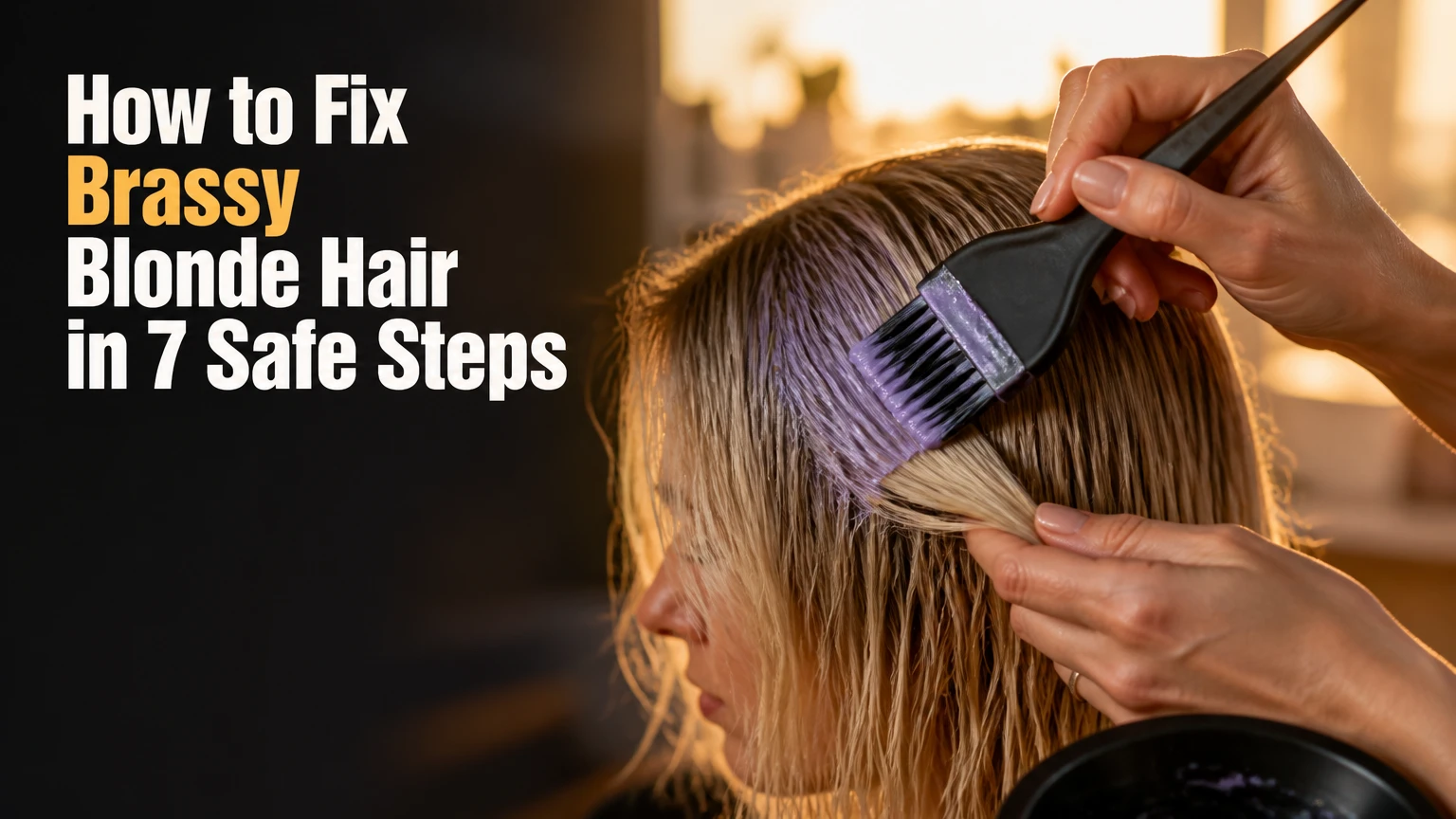
To fix brassy blonde hair, identify whether the unwanted warmth is yellow, orange, or red, then remove buildup and apply the complementary pigment. Purple corrects yellow, blue corrects orange, and green can soften red. Finish with conditioning, reduce heat and mineral exposure, and use a salon toner when brassiness is strong or uneven.
Key Facts at a Glance
- Purple pigment neutralizes yellow blonde hair, while blue pigment neutralizes orange and copper tones.
- Clarifying shampoo removes product residue, but a chelating shampoo is more appropriate for hard-water metal buildup.
- Pigmented shampoo usually lasts one to three washes; a demi-permanent toner commonly lasts four to six weeks.
- Purple shampoo cannot make under-lightened orange hair platinum because toning deposits color without lifting the hair.
- Porous, bleached ends absorb cool pigment faster than healthy roots and may turn gray, violet, or blue.
- A typical salon toner service costs about $40-$100 or more, depending on location, stylist, and whether correction is required.
What Brassy Blonde Hair Means
Brassy blonde hair has unwanted yellow, orange, copper, or red warmth showing through a lightened or color-treated result. The warmth usually appears when toner fades, when dark hair has not been lightened far enough, or when minerals, ultraviolet exposure, heat, and oxidation alter the visible color.
Hair lightening exposes underlying pigments in stages. Very dark hair generally reveals red and red-orange first, medium brown exposes orange, dark blonde exposes yellow-orange, and pale blonde exposes yellow. A toner can visually balance those pigments, but it cannot replace the lifting process required to reach a lighter level.
Brassiness also has a surface cause. Copper and iron in hard water can attach to the hair fiber and create orange, dull, or rusty-looking reflections. Styling products, dry shampoo, smoke, and heavy oils can make blonde hair appear warmer even when the underlying color has not changed.
Is brassiness the same as damaged hair?
Brassiness and hair damage are related but not identical. Damaged hair is more porous, so it loses toner quickly and absorbs replacement pigment unevenly; however, healthy blonde hair can still look brassy after sun exposure, hard-water contact, or natural toner fade.
A simple diagnostic rule helps: warmth that appeared gradually after several washes may need pigment or mineral removal, while warmth that existed immediately after bleaching often indicates insufficient lift or an unsuitable formula. Do not solve under-lightened orange hair with repeated purple shampoo.
How to Choose the Correct Neutralizing Pigment
Choose pigment by the visible undertone, not by the word “blonde” on the bottle. Purple works on pale yellow, blue works on orange or copper, and green is reserved for red warmth in darker brown or chestnut hair.
| Visible unwanted tone | Correcting pigment | Suitable hair example | Product type |
|---|---|---|---|
| Pale lemon yellow | Violet or purple | Platinum, level 9-10 blonde | Purple shampoo or violet gloss |
| Golden yellow | Violet-blue | Beige or level 8-9 blonde | Violet-blue mask or toner |
| Yellow-orange | Blue-violet | Dark blonde, bronde highlights | Blue-violet conditioner |
| Clear orange or copper | Blue | Level 6-8 balayage or brunette highlights | Blue shampoo or blue toner |
| Red-orange | Blue-green | Dark blonde or light brown | Professional corrective toner |
| Red or burgundy warmth | Green | Chestnut or dark brown base | Salon color correction |
Color correction is subtractive. A small amount of complementary pigment can reduce warmth, but excessive pigment can make blonde hair look dull or smoky. Hair porosity, application time, and the concentration of the product change the result, so a hidden strand test is more reliable than a full-head guess.
How to Fix Brassy Blonde Hair Step by Step
The safest home process takes 20-45 minutes and uses four escalating stages: remove buildup, neutralize the correct warmth, condition the fiber, and adjust the maintenance routine. The factor that most determines success is accurate undertone diagnosis.
Before You Start
| Requirement | Typical specification | Why it matters |
|---|---|---|
| Total time | 20-45 minutes | Includes washing, treatment, and conditioning |
| Difficulty | Low for shampoo, moderate for gloss | Pigment strength and porosity increase risk |
| Budget | $10-$45 for shampoo, $15-$35 for gloss | Salon correction commonly costs $40-$100 or more |
| Tools | Gloves, towel, wide-tooth comb, timer | Prevents stained hands and uneven saturation |
| Prerequisite | Strand test on 1-2 cm section | Shows speed of pigment absorption |
| Water | Lukewarm, followed by cool rinse | Reduces unnecessary cuticle swelling |
Step 1: Remove Buildup
Wash once with a clarifying shampoo for styling residue, or use a chelating treatment according to its label when hard-water minerals are suspected. Leave a chelating product on only for the stated time, because repeated aggressive cleansing can increase dryness and porosity.
Apply the cleanser mainly to the scalp and lengths where residue is visible. Rinse thoroughly before judging the color in daylight. Malibu C identifies metal and mineral buildup as a contributor to unwanted blonde discoloration, while ordinary clarifying shampoo is primarily designed for cosmetic residue.
You will know this step worked when the hair feels lighter, the water runs clear, and the blonde looks less coated rather than dramatically cooler. A common mistake is repeating the wash several times in one session; stop after one treatment and condition before reassessing.
Step 2: Neutralize the Warmth
Apply purple shampoo to yellow hair or blue shampoo to orange hair, starting with the warmest sections and leaving the least porous or palest areas for last. Begin with 2-3 minutes, rinse, and increase toward 5 minutes only after a strand test shows insufficient correction.
| Hair condition | Starting pigment time | Maximum home starting point | Application method |
|---|---|---|---|
| Pale, healthy blonde | 1-2 minutes | 3 minutes | Dilute with regular shampoo if needed |
| Golden blonde | 2-3 minutes | 5 minutes | Saturate evenly with gloves |
| Orange balayage | 3-5 minutes | 7 minutes | Use blue product, not purple |
| Porous bleached ends | 30-60 seconds | 2 minutes | Apply ends last and monitor visually |
| Gray or silver hair | 1 minute | 3 minutes | Use weak violet concentration |
Pigmented shampoo deposits color on the outside of the hair and usually fades within one to three washes. Massage it through evenly, comb once with a wide-tooth comb, and rinse when the warmth softens rather than waiting for the hair to look gray in the shower.
You will know it worked when the blonde appears more balanced under natural light, not merely darker under bathroom lighting. The common mistake is using blue and purple products together during the first attempt, which can create a muddy blue-violet cast.
Step 3: Use a Toner or Gloss for Strong Brassiness
Use a deposit-only gloss or professional demi-permanent toner when shampoo cannot correct the warmth evenly. A gloss usually processes for 5-20 minutes and lasts about 2-4 weeks, while a salon demi-permanent toner often processes for 20-30 minutes and lasts approximately 4-6 weeks.
At-home toner formulas vary widely. Some require a dedicated activator, while others are ready to use, so follow the manufacturer’s mixing ratio rather than substituting developer. Avoid permanent box dye as a quick toner because permanent color can add unnecessary alkalinity, darken porous areas, and complicate a later correction.
| Correction method | Processing time | Typical durability | Typical cost | Precision |
|---|---|---|---|---|
| Purple or blue shampoo | 3-7 minutes | 1-3 washes | $10-$45 | Low |
| Pigmented mask | 5-15 minutes | 2-5 washes | $15-$35 | Moderate |
| In-shower gloss | 5-20 minutes | 2-4 weeks | $15-$35 | Moderate |
| Demi-permanent salon toner | 20-30 minutes | 4-6 weeks | $40-$100+ | High |
| Full color correction | 2-5 hours | Varies by formula | $150-$500+ | Very high |
You will know the toner is appropriate when the strand test produces a neutral beige or cool blonde without a darker band. The common mistake is applying one formula from roots to ends when the roots are orange and the ends are already pale; section-specific formulas are safer.
Step 4: Recondition the Hair
Apply a moisturizing conditioner or mask for 5-10 minutes after pigment correction. A bond-building treatment may help reduce the feel of bleach-related weakness, but it cannot repair a chemically destroyed hair shaft or permanently seal split ends.
Low-pH conditioners can temporarily reduce friction and improve the feel of the cuticle surface. Use a product suited to the hair’s condition: moisture for rough, dry hair; occasional protein for weak, stretchy hair; and neither category excessively if the hair becomes stiff or brittle.
You will know conditioning helped when wet hair detangles with less resistance and dries with reduced roughness. The common mistake is using a strong protein treatment after every toning session, which can make already-stiff hair feel harder.
Step 5: Rinse and Dry Without Adding Heat Damage
Rinse with lukewarm or cool water, blot with a towel, apply heat protection, and dry at a moderate setting. Hot tools and prolonged high-temperature blow-drying accelerate dryness, increase porosity, and can make cool pigment disappear faster.
Do not judge the final tone while the hair is soaking wet. Dry the hair completely, inspect it in daylight, and wait until the next day before performing another correction.
Step 6: Reassess Uneven Areas
Separate the hair into roots, mids, and ends under neutral lighting. If only one zone remains warm, correct that zone rather than repeating a full-head treatment.
A practical timing rule is to apply pigment to resistant orange areas first and porous pale ends last. Hair near the scalp may process faster because scalp warmth accelerates chemical processing, while old highlighted ends may absorb direct dye immediately.
Step 7: Establish a Maintenance Schedule
Use a pigmented shampoo every 2-4 washes rather than automatically using it every wash. The correct frequency depends on how quickly warmth returns, how often the hair is washed, and how porous the blonde is.
Alternate the toning cleanser with a gentle color-safe shampoo and use a conditioning mask once weekly. If a purple or blue product leaves visible residue, reduce contact time before reducing all conditioning, because dryness can make future toning less even.
Which Correction Method Should You Choose?
Pigmented shampoo is the lowest-risk option for mild, even warmth; a gloss offers longer wear and more shine; and professional toner is the best choice for strong, patchy, or level-related brassiness. No single method is suitable for every blonde because deposit strength, porosity, and starting level change the result.
| User situation | Best first option | Avoid first | Expected result |
|---|---|---|---|
| Pale yellow platinum | Purple shampoo | Blue shampoo | Softer, cleaner blonde |
| Orange balayage | Blue shampoo or salon toner | Purple-only product | Reduced copper reflection |
| Uneven yellow roots | Localized demi toner | Full-head purple wash | More even root tone |
| Porous bleach-damaged ends | Diluted gloss | Long pigment processing | Controlled neutralization |
| Heavy hard-water buildup | Chelating treatment | Repeated purple washes | Cleaner base for toning |
| Strong brass after bleaching | Salon assessment | Permanent box dye | Correct level and tone |
When Is a Salon Toner the Better Choice?
A salon toner is preferable when brassiness is orange, appears in bands, follows a bleach service, or exists alongside breakage. A stylist can assess the hair level, select a violet, blue, ash, beige, or natural balance, and vary the formula across roots and ends.
Salon toning is not a substitute for lifting. If the hair remains several levels darker than the desired blonde, a toner may neutralize warmth while leaving the result too dark. Further lightening may be necessary, and repeated bleaching at home creates a substantial breakage risk.
Common Mistakes and How to Fix Them
Purple shampoo does nothing
Purple shampoo does not neutralize strong orange warmth because purple is opposite yellow, not orange. Use a chelating wash first if the hair has mineral buildup, then choose blue or blue-violet pigment if the orange remains.
Hair turns purple, blue, or gray
Excess pigment usually results from porous hair, excessive processing time, or repeated toning before the previous deposit has faded. Wash once with a regular shampoo, reassess when dry, and use a clarifying wash only if the color remains visibly excessive; repeated harsh cleansing can worsen porosity.
Hair turns green
Green can appear when blue pigment combines with a porous yellow base or when mineral deposits interact with color. Stop blue and purple products, use a gentle cleansing wash, and seek a colorist if the green persists. Do not apply red dye randomly, because red intensity can create a new uneven result.
The roots are yellow but the ends look dull
This pattern often indicates different porosity or processing history rather than one uniform color problem. Apply pigment briefly to the roots, dilute or skip the ends, and use a conditioning treatment on the dull sections.
Hair becomes darker after toning
A toner can make hair look darker when the formula is too deep, when porous strands absorb excess ash, or when the chosen shade is below the hair’s visual level. Allow several washes before correcting, unless the result is severely blue, green, or gray.
Brassiness returns after one wash
Rapid fade suggests porous hair, mineral exposure, frequent shampooing, or insufficient toner deposit. Add a shower filter for particulate reduction, use a chelating treatment periodically when appropriate, lower washing frequency if practical, and ask a colorist about a longer-wearing demi gloss.
Situation-Based Fixes
How do you fix brassy balayage?
Use blue pigment on orange or copper balayage, concentrating on darker highlighted areas and protecting pale ends with conditioner. Balayage often contains several levels, so one purple product can leave dark pieces warm and light pieces violet.
How do you fix hot roots?
Apply a root-focused demi-permanent toner selected for the actual yellow or orange undertone, keeping the formula off already-neutral ends. Scalp heat can accelerate processing, so inspect the roots frequently and follow the toner’s processing instructions rather than extending time.
Can you tone bleach-damaged hair?
You can tone bleach-damaged hair, but use a strand test, a gentle deposit-only gloss, short processing time, and intensive conditioning. Avoid additional lightener when the hair is stretchy, snapping, severely tangled, or painful on the scalp; color correction cannot reverse structural breakage.
Does a shower filter prevent brassiness?
A shower filter may reduce some sediment and chlorine, but many basic filters do not remove all dissolved calcium, magnesium, copper, or iron. A periodic chelating treatment and professional mineral-removal service may be necessary in hard-water areas.
How to Prevent Blonde Hair From Turning Brassy
Prevent brassiness by reducing mineral contact, ultraviolet exposure, heat damage, and unnecessary washing. Prevention works better when the routine addresses the specific cause rather than relying on purple shampoo after every wash.
| Cause | Observable sign | Prevention | Typical frequency |
|---|---|---|---|
| Toner fade | Warmth increases after washing | Gentle color-safe shampoo | Every wash |
| Hard-water metals | Rusty, dull, or orange cast | Chelating treatment | Every 2-6 weeks |
| UV exposure | Dry, faded summer blonde | UV-protective leave-in and hat | Each outdoor exposure |
| Heat styling | Dry, faded ends | Heat protectant below tool temperature | Every styling session |
| Product residue | Coated, matte blonde | Clarifying shampoo | Every 2-4 weeks |
| Frequent washing | Toner disappears quickly | Wash less often when scalp permits | Individual schedule |
Use lukewarm water, avoid applying purple shampoo automatically, and condition the lengths after every cleansing session. Schedule salon toning before the blonde becomes strongly orange, because mild maintenance usually requires less chemical processing than a full correction.
Time, Cost, and Difficulty
A mild yellow cast can often be corrected at home in 10-20 minutes with a pigmented cleanser. Strong orange, uneven roots, mineral buildup, or fragile hair can require 30-60 minutes at home or a salon appointment lasting 1-3 hours.
| Service or product | Typical price range | Time commitment | Damage risk |
|---|---|---|---|
| Drugstore purple shampoo | $8-$18 | 5-10 minutes | Low, but drying with overuse |
| Professional pigment system | $20-$45 | 5-15 minutes | Low to moderate |
| Chelating treatment | $15-$35 | 10-20 minutes | Moderate if overused |
| At-home gloss | $15-$35 | 20-40 minutes | Low to moderate |
| Salon toner | $40-$100+ | 45-90 minutes | Low when correctly formulated |
| Bleach correction | $150-$500+ | 2-5 hours | High |
Prices vary by country, salon tier, hair length, and whether a blow-dry or corrective lightening service is included. An at-home product is not automatically cheaper if a wrong undertone creates a second salon correction.
What Hair Electrolysis Can and Cannot Do
Hair electrolysis does not remove brassiness, alter blonde pigment, or neutralize yellow and orange tones. Electrolysis uses an electrical current to disable individual hair follicles for permanent hair removal, while brassiness is a color issue within the hair shaft.
Electrolysis may be relevant to facial or body hair, but it should never be used as a hair-color treatment. Blonde hair toning requires cosmetic pigment, gloss, or professional color formulation, not follicle treatment.
FAQ
Can I fix brassy hair without dye?
You can reduce mild brassiness without permanent dye by using a purple or blue conditioner, removing mineral buildup, and protecting the hair from UV and heat. These methods deposit temporary pigment or improve surface appearance, but they cannot lighten under-processed orange hair.
Should I use purple shampoo after bleaching?
Use purple shampoo only after the hair has reached a suitable blonde level and the visible issue is yellow. If freshly bleached hair is orange, purple shampoo is the wrong match; use professional assessment before applying stronger pigment to fragile hair.
How often should I use blue shampoo?
Start with blue shampoo once every 2-4 washes for orange or copper warmth. Leave it on for 2-5 minutes, inspect the result after drying, and reduce frequency if the hair becomes gray, blue, dull, or dry.
Can baking soda remove brassy tones?
Baking soda is not a controlled toner remover and can increase roughness or dryness. A labeled clarifying or chelating product provides more predictable cleansing, while a colorist is safer for strong artificial color or uneven correction.
Will lemon juice make blonde hair less brassy?
Lemon juice does not reliably neutralize brassiness and can dry hair while increasing photosensitivity. Lemon may create uneven lightening under sunlight, but it does not provide the controlled violet or blue pigment needed for color correction.
When should I stop treating brassiness at home?
Stop home correction when hair is breaking, stretchy, severely porous, green, banded, or repeatedly darkening after toner. A salon colorist should evaluate the hair level and condition before further bleach, developer, or concentrated corrective pigment is used.
The Bottom Line
To fix brassy blonde hair, diagnose the visible tone first: choose purple for yellow, blue for orange, and professional correction for red, banded, or under-lightened warmth. Remove buildup before toning, process porous ends briefly, condition after every correction, and maintain the result with less frequent washing and controlled pigment use.