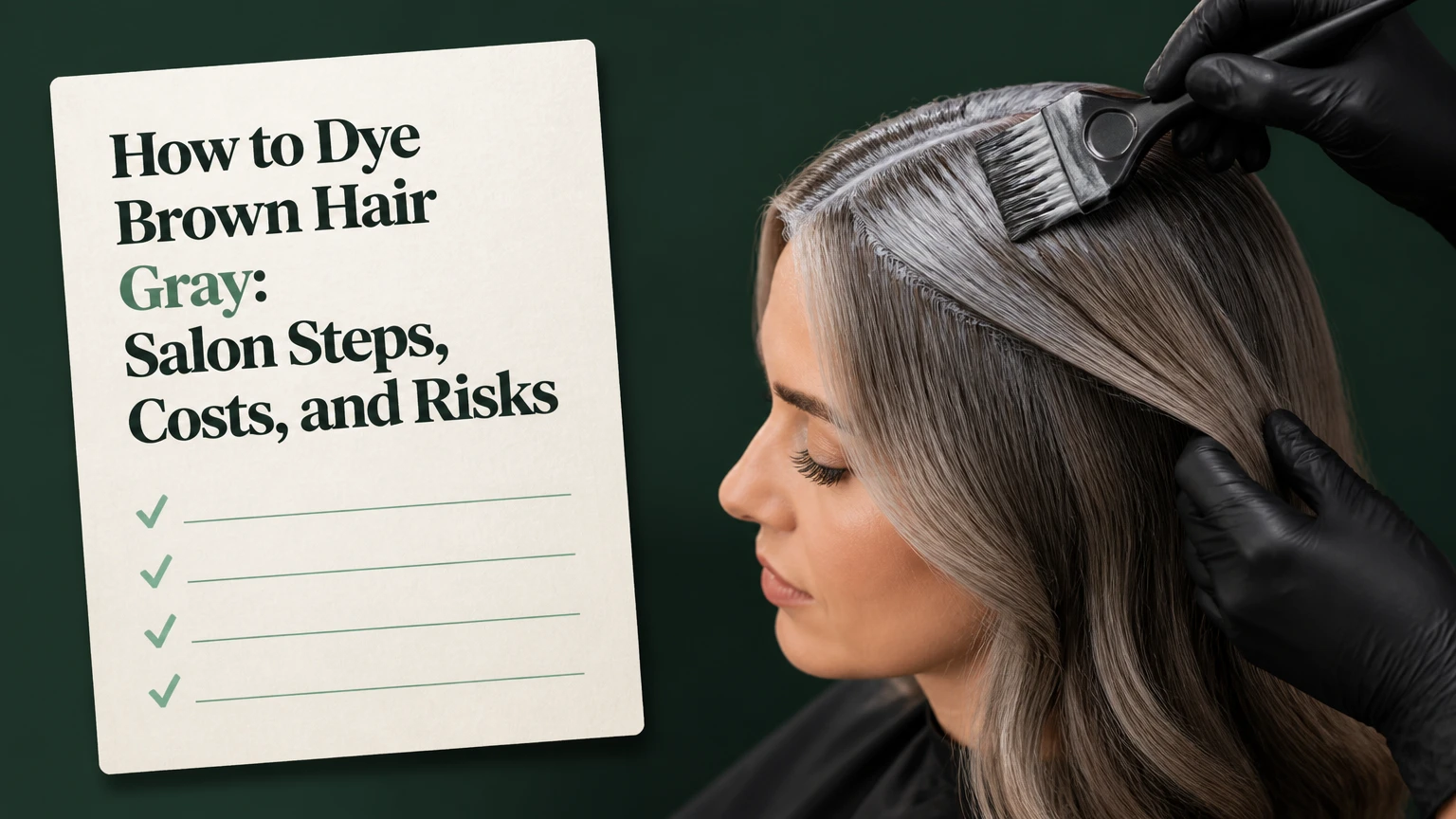
To dye brown hair gray, hair usually must be lightened to a very pale yellow, typically level 9 or 10, before a cool gray, silver, or violet-based toner is deposited. Brown hair may require one or more bleaching sessions, especially when it contains box dye. A professional colorist is the safest choice because uneven lift and overlapping bleach can cause breakage.
Key Facts at a Glance
- Brown hair becomes gray through two chemical stages: lightening removes natural or artificial pigment, then toner deposits a cool reflect.
- A clean pale silver result generally requires a level 9 or 10 base, similar to pale yellow or the inside of a banana peel.
- Gray toner cannot reliably cover medium brown hair because translucent gray pigment does not replace the darker brown background.
- Black box dye, henna, metallic dyes, relaxers, and previous bleach can substantially change the procedure and risk level.
- A salon transformation commonly takes 2-7 hours per appointment and may require multiple appointments.
- Gray and silver tones usually fade faster than the lightened base, often within approximately 8-12 shampoos, depending on porosity, washing, and toner type.
What Happens When Brown Hair Turns Gray?
Brown-to-gray hair color is usually a double-process service. The first process is lightening, which breaks down melanin and artificial color. The second process is toning or coloring, which places a gray, silver, ash, or violet reflect over the lightened hair.
Hair colorists describe lightness using levels from 1, black, through 10, palest blonde. Brown hair commonly sits around levels 2-5. As brown hair lightens, the visible underlying pigment usually moves through red, red-orange, orange, gold, and yellow stages.
Gray is not a single pigment. A cool gray formula may contain blue, violet, ash, neutral, or pearl components, and the correct mixture depends on the remaining warmth. Violet helps counter yellow, while blue can counter orange. Blue applied to yellow-orange hair may produce a green or muddy result.
The lightened base controls the result more than the gray toner does. Toner refines an appropriate background; it does not erase several levels of darkness.
How Light Must Brown Hair Be?
Brown hair usually needs to reach pale yellow, around level 9 or 10, for a bright silver or platinum-gray result. A darker smoky gray can work on a level 7 or 8 base, but the result will look charcoal, mushroom, or muted beige rather than reflective silver.
| Desired result | Typical base required | Likely appearance | Toning direction |
|---|---|---|---|
| Platinum silver | Level 10 pale yellow | Bright, icy silver | Violet, pearl, blue-violet |
| Soft gray blonde | Level 9 yellow | Light gray with blonde dimension | Violet, pearl, neutral |
| Smoky gray | Level 7-8 gold-yellow | Charcoal or mushroom gray | Ash, blue, neutral |
| Dark graphite | Level 5-6 orange-brown | Deep slate or charcoal | Blue, ash, neutral |
| Gray-brown gloss | Level 4-6 brown | Subtle cool sheen | Demi ash or neutral brown |
A strand test determines whether the hair can reach the required level without becoming weak. The test is more reliable than a product box photograph because porosity, density, prior color, and hair diameter affect lift.
Can Brown Hair Become Gray Without Bleach?
Brown hair generally cannot become light silver gray without lightening first, because gray dye is too translucent to hide a dark brown base. Without bleach, the realistic alternatives are charcoal glosses, smoky demi-permanent color, gray wax, colored sprays, or gray extensions.
A dark ash or graphite demi-permanent color can create a cool reflection on medium brown hair. It will not create pale silver strands. Temporary waxes and sprays coat the outside of the hair and offer the lowest structural risk, although transfer, stiffness, and uneven coverage remain common limitations.
Some products marketed as gray dye without bleach contain oxidative color or high-lift chemistry. Read the ingredient and developer instructions rather than relying on the marketing phrase. A product that uses developer may still alter the hair structure.
| No-bleach option | Suitable starting hair | Typical duration | Main limitation |
|---|---|---|---|
| Gray color wax | Brown to dark blonde | 1 shampoo | Texture and transfer |
| Gray spray | Any dry hair | 1 shampoo | Surface coverage only |
| Colored conditioner | Light blonde to gray | 2-8 shampoos | Weak result on brown |
| Demi graphite gloss | Light brown to blonde | 4-พ8 weeks | Produces charcoal, not silver |
| Gray extensions | Any length or color | 6-12 weeks with care | Requires matching and attachment |
The least damaging option is not automatically the most natural-looking option. Temporary products are safest for a one-day experiment, while a demi gloss is more practical for a repeated smoky effect.
Before You Start: Safety, Tools, and Tests
A brown-to-gray transformation requires a consultation, a strand test, and an allergy test where the product instructions require one. The FDA advises following package directions and performing the recommended skin test before using oxidative hair color; a negative test does not guarantee that an allergy cannot develop later.
Do not bleach hair that is already gummy, snapping, severely porous, or irritated at the scalp. Do not apply bleach over unknown metallic-salt color, some henna mixtures, or overlapping previous lightener without professional evaluation. These combinations can create excessive heat, breakage, or unpredictable color.
The 48-hour unwashed-hair rule is not universal. Avoid harsh shampooing immediately before a scalp bleach, but do not rely on oil as protection from chemical injury. Product instructions and the colorist’s assessment determine preparation.
| Preparation item | Typical specification | Purpose | Important limit |
|---|---|---|---|
| Clarifying shampoo | 1 wash, used before consultation or test | Removes buildup | Can dry porous hair |
| Gloves | Chemical-resistant, disposable | Protects hands | Replace if torn |
| Nonmetal bowl | 1 bowl | Holds lightener | Avoid reactive metal |
| Sectioning clips | 4-8 clips | Creates controlled sections | Keep contaminated clips away |
| Bond treatment | Brand-specific amount | Reduces some service stress | Does not make bleach risk-free |
| Petroleum barrier | Hairline and ears only | Reduces skin staining | Never mix into lightener |
| Timer | Digital, visible | Controls processing | Never exceed product instructions |
Step 1: Assess the Starting Hair
Identify whether the brown is natural, demi-permanent, permanent, or box-dyed. A colorist should also record previous bleach, highlights, keratin treatments, relaxers, perms, henna, and metallic dyes because each history changes the safe formula.
Check the hair in four zones: roots, mid-lengths, ends, and previously colored bands. New growth may lift quickly because scalp heat accelerates processing, while old ends may contain layers of artificial pigment and respond slowly.
You will know the assessment is useful when the color history and strand test reveal the weakest area before the full service begins. The common mistake is judging only the visible surface layer and missing dark dye underneath.
Step 2: Perform a Strand and Allergy Test
Separate a small hidden section and test the intended lightener, then test the proposed toner on the lifted strand. Record the developer strength, mixing ratio, processing time, and final elasticity.
A healthy test strand should stretch slightly and return without becoming gummy. If the strand stays elongated, feels gummy, breaks during combing, or loses its surface, stop the transformation. A strand test cannot predict every outcome, but it identifies obvious incompatibility.
Follow the dye manufacturer’s allergy-test procedure, usually 48 hours before oxidative color. Stop immediately for burning, swelling, blistering, breathing difficulty, or intense itching, and seek medical care for severe symptoms.
Step 3: Lighten the Brown Hair
Professional lightening commonly uses powder or cream lightener with a developer selected for the hair’s condition and the required lift. A universal 20-volume or 30-volume formula is unsafe advice because developer strength, product chemistry, scalp application, and hair history vary.
Colorists normally apply lightener to resistant mid-lengths and ends before the warmer root area, while preserving even saturation and avoiding previously lightened hair. The exact order can change for virgin hair, short hair, fine hair, or a corrective service.
Process only within the manufacturer’s stated range and inspect the hair during development. Do not force a pale result by adding more time after the safe limit. If the hair reaches orange or strong gold before the limit, rinse, condition, assess, and schedule another session rather than pushing the fiber past its tolerance.
You will know the lift is ready when the hair reaches the planned level evenly, not merely when one strand looks pale. The common mistake is applying fresh bleach over already lightened ends, which creates overlapping damage.
Step 4: Rinse, Assess, and Decide Whether to Continue
Rinse until all lightener is removed, then assess the hair while it is clean and damp. The colorist should compare the result with the target level and inspect elasticity, porosity, banding, and scalp comfort.
If the hair remains too dark or uneven, a second lightening session may be safer than forcing completion on the same day. The next appointment may occur days or weeks later, depending on condition and the professional’s evaluation.
Do not use purple shampoo as a substitute for additional lift. Purple shampoo can reduce the visual intensity of yellow on sufficiently light hair, but it cannot turn orange level 8 hair into level 10 hair.
Step 5: Deposit the Gray, Silver, or Charcoal Tone
Apply a toner or demi-permanent color selected for the actual lightened background. A level 10 pale yellow base may accept a sheer silver-violet formula, while a level 8 gold base may require a deeper beige, ash, or smoky result to avoid a hollow or green cast.
The formula, developer, ratio, and timing must follow the brand’s technical instructions. Products sold under similar names can use different alkalizers, pigment loads, and processing requirements. Wella Color Charm, Schwarzkopf, L’Oréal Professionnel, and other systems are not interchangeable by name alone.
Watch porous ends carefully because they may absorb cool pigment faster than the roots. Apply evenly, comb only as needed, and remove the toner when the visual target is reached or the instructions specify.
You will know toning worked when the hair looks evenly cool without gray-white roots, green bands, or muddy ends. The common mistake is leaving a violet toner on longer to obtain a lighter silver result, even though extra time usually creates a darker or more purple stain.
Step 6: Rinse and Begin Color-Safe Care
Rinse thoroughly using the product’s directions and apply the recommended conditioner or treatment. Cold water does not literally close the cuticle, despite a common salon claim, but cooler water and gentle washing can reduce friction and help limit rapid color loss.
Avoid assuming that waiting exactly 72 hours is mandatory for every formula. Follow the toner manufacturer’s directions, then wash with a gentle, color-safe cleanser when needed.
Use a wide-tooth comb on wet hair, reduce hot-tool temperature, and apply heat protection. Gray hair often feels drier because the lightening phase has removed lipid protection and increased porosity.
Which Gray Method Fits Your Hair?
The best method depends on the target shade, current condition, color history, maintenance tolerance, and whether natural gray growth must remain visible. Full bleach creates the most uniform silver, while highlights create a softer grow-out and preserve some brown depth.
| Method | Starting hair | Appointment or application time | Typical maintenance | Damage exposure |
|---|---|---|---|---|
| Full double process | Virgin brown, strong condition | 4-7 hours | Root service every 4-8 weeks | High |
| Silver highlights | Brown with mixed gray | 3-5 hours | Refresh every 8-16 weeks | Moderate |
| Gray balayage | Brown with healthy lengths | 3-6 hours | Refresh every 10-16 weeks | Moderate |
| Demi graphite gloss | Light or medium brown | 1-2 hours | Refresh every 4-8 weeks | Low to moderate |
| Gray wax or spray | Any condition | 5-20 minutes | Reapply after washing | Very low structurally |
Full Double-Process Platinum Gray
Full double-process color is best for an even, high-impact silver result. The service lightens most or all of the hair, then deposits a customized toner, often with a root shadow to soften regrowth.
The base remains lightened permanently, but the gray tone fades. New brown growth can become visible within two to six weeks, depending on contrast and growth rate. This method is a poor choice for fragile ends or anyone unwilling to schedule regular root maintenance.
Highlights, Herringbone, and Gray Blending
Highlights are often the strongest choice for someone growing out natural gray. Fine woven sections imitate the irregular distribution of white and gray strands while leaving some brown hair untouched.
Herringbone gray blending uses strategic placement rather than a solid bleach-out. The technique cannot make every brown strand silver, but it reduces the hard horizontal line created by a full-head lightener. Maintenance commonly occurs every 8-16 weeks rather than every month.
Demi-Permanent Charcoal or Smoky Gray
A demi-permanent gloss suits someone who wants a cool, darker effect without reaching level 10. On brown hair, the result may resemble graphite, mushroom brown, smoky espresso, or charcoal rather than silver.
This route generally causes less structural change than bleaching, but it is not risk-free. Some formulas use an activator and can alter the cuticle or stain porous areas. It also cannot create pale gray on dark brown hair.
Temporary Gray Products
Gray sprays, waxes, mousses, and chalks are useful for an event or a low-risk color preview. They coat the hair surface instead of substantially removing melanin, so they wash out quickly and may transfer to clothing, bedding, or hands.
Temporary color is not good for swimming, high humidity, pale clothing, or a polished permanent result. It is useful when hair condition makes bleach inappropriate.
Should You Bleach Brown Hair at Home?
Most people should not perform a full brown-to-silver bleach transformation at home, particularly when the hair contains box dye, highlights, henna, relaxer, or unknown color. The main risks are uneven saturation, hot roots, chemical overlap, scalp injury, and breakage that appears after rinsing.
At-home kits also encourage a false sense of precision. A box cannot see that one section contains three layers of dark dye while another section was bleached six months earlier. Professional colorists can adjust placement and stop processing when the fiber reaches its limit.
DIY may be reasonable for a small temporary spray or a carefully selected demi gloss on healthy, untreated hair. It is a poor trade for a global silver transformation.
| Route | Typical cost | Typical total time | Best use | Main failure risk |
|---|---|---|---|---|
| DIY temporary product | $8-$35 | 10-30 minutes | One event | Transfer and patchiness |
| DIY demi gloss | $15-$45 | 1-2 hours | Smoky dark result | Uneven porosity |
| Salon highlight blend | $150-$500+ | 3-5 hours | Natural gray transition | Banding |
| Salon double process | $250-$800+ | 4-7 hours per session | Uniform silver | Breakage or multiple visits |
| Corrective color service | $300-$1,000+ | 5-10 hours across visits | Box-dye correction | Cost and uncertain endpoint |
Prices are typical broad ranges, not universal rates. Hair length, density, city, stylist expertise, and corrective history can change the quote substantially.
What Changes If Brown Hair Has Box Dye?
Previously dyed brown hair is more difficult to turn gray because artificial pigment may resist ordinary lightener, while the natural root lifts faster. Color remover can reduce some oxidative artificial pigment, but it does not reliably remove every dye molecule and cannot replace controlled lightening.
Black or dark brown box dye may require multiple appointments. The colorist may create a warm intermediate result first, then refine the color after assessing the hair’s condition. Trying to force level 10 in one session often creates fragile, uneven hair.
Henna and metallic-salt products require special caution. Ask for ingredient records or perform professional testing before applying lightener. Unknown color history is itself a reason to delay the service.
Why Did the Hair Turn Orange, Green, or Muddy?
Orange hair usually means the hair has not been lifted light enough for the intended gray formula. Green hair commonly results when blue or ash pigment overlays a yellow-orange background, although porosity and product composition also affect the final color.
| Problem | Likely cause | Immediate action | Do not do |
|---|---|---|---|
| Bright orange | Level 7-8 background | Reassess lift and target a darker ash result | Add pale silver toner |
| Yellow roots, dark ends | Uneven saturation or box dye | Correct zones separately | Apply bleach everywhere |
| Green cast | Blue over yellow-orange hair | Stop cool pigment and seek correction | Reapply blue toner |
| Purple ends | Porous ends absorbed violet | Gentle cleansing and neutral assessment | Bleach immediately |
| Gummy hair | Over-processing or overlap | Stop chemical services and cut heat | Brush aggressively while wet |
| Scalp burning | Irritation or chemical injury | Rinse immediately and seek medical advice | Continue processing |
A professional may use a controlled corrective gloss, a color remover, a targeted re-lightening service, or a haircut. Re-bleaching immediately after a failed toner is not automatically the solution.
How Do You Maintain Gray and Silver Hair?
Gray and silver color generally requires washing less often, using a gentle cleanser, reducing hot water, and refreshing tone with a violet or silver conditioner when the hair is sufficiently light. Purple products should be used according to the label, often once weekly or less, because porous hair can become lavender or dull.
Use a moisturizing conditioner after every wash and alternate it with a bond or strengthening treatment if the hair tolerates that product. A bond builder can support the feel and manageability of damaged hair, but no treatment restores permanently broken keratin fibers.
| Maintenance action | Typical frequency | Purpose | Overuse problem |
|---|---|---|---|
| Gentle shampoo | 1-3 times weekly | Removes oil and buildup | Faster fading if overwashed |
| Purple conditioner | Every 1-2 weeks | Reduces yellow appearance | Lavender or dull deposits |
| Deep conditioner | Weekly | Improves softness | Weighed-down fine hair |
| Heat protectant | Every hot-tool use | Reduces thermal stress | Product buildup |
| Toner refresh | Every 4-8 weeks | Restores gray reflect | Dark or uneven deposits |
| Root lightening | Every 4-8 weeks | Matches new growth | Overlap and breakage |
Hard water, chlorine, heat, sun exposure, and highly porous ends can accelerate fading. A shower filter may reduce mineral residue, but it does not replace a chelating treatment when buildup is significant.
Which Gray Method Causes the Least Damage?
Temporary gray color causes the least structural damage because it coats the hair without deliberately oxidizing melanin. A demi-permanent charcoal gloss usually causes less damage than bleach, while highlights expose less total hair than a full double process.
Damage depends on overlap, developer strength, processing time, hair history, and fiber condition. A lower developer is not automatically harmless, and a salon appointment is not automatically safe if the lightener overlaps compromised hair.
The safest practical decision for fragile or fine brown hair is usually a temporary product, gray extensions, or a darker demi gloss. Those methods cannot provide platinum silver, and that limitation should be accepted before purchase.
How Can Brown Hair Transition to Natural Gray?
Brown hair can transition to natural gray through fine highlights, strategic lowlights, a softer root shadow, and regular toning that connects the artificial color with incoming white growth. A full bleach-out is not required when the goal is blended transition rather than solid silver.
Ask for gray blending, herringbone highlights, or a low-maintenance silver transition. Bring photographs showing the desired percentage of brown remaining because “gray” can mean salt-and-pepper, pewter, silver blonde, or graphite.
A root shadow can reduce the contrast between new growth and lightened lengths, but it should not be applied so darkly that it creates another hard band. The grow-out plan should be discussed before the first lightening service.
Does Hair Electrolysis Help With Gray Hair?
Hair electrolysis does not dye, lighten, or gray the hair shaft. Electrolysis uses a probe to treat individual follicles for hair removal, so it is relevant to unwanted facial or body hair, not to changing brown scalp hair into gray.
Electrolysis can remove a few unwanted dark or gray hairs from areas such as the chin, but it cannot create a gray hairstyle. Hair color transformation requires cosmetic color products, while follicle removal requires an appropriately licensed electrologist.
Do not confuse electrolysis with salon color terminology such as electrical tools, heat styling, or lightening systems. They address different biological structures and different outcomes.
Frequently Asked Questions
Can I dye brown hair silver in one day?
You may reach silver in one day only when the hair is healthy, untreated or compatible with the planned chemistry, and light enough to lift evenly. Medium brown, long, dense, box-dyed, or previously bleached hair often needs multiple sessions. A strand test and elasticity assessment determine whether same-day completion is responsible.
Will gray dye cover dark brown hair?
Gray dye will not reliably cover dark brown hair with a pale gray result because most gray formulas are translucent and deposit cool pigment rather than remove substantial darkness. A dark graphite or charcoal color may create a cooler reflection, but silver usually requires prior lightening.
How long does gray hair dye last?
The gray tone commonly lasts about 8-12 shampoos, although demi-permanent formulas may remain visible for 4-8 weeks. Porous hair can lose violet and silver pigment quickly, while cooler water, infrequent washing, gentle cleanser, and periodic toning can extend the visual result.
Can purple shampoo make brown hair gray?
Purple shampoo cannot make brown hair gray because it deposits a small amount of violet pigment and does not remove brown melanin. Purple shampoo works best on pale blonde, gray, or silver hair with yellow discoloration. On brown hair, the effect is usually minimal or invisible.
Is gray hair harder to maintain than brown hair?
Gray and silver hair usually require more maintenance than natural brown hair because the base must remain very light and the cool toner fades. Root contrast can appear within four to eight weeks, while toner refreshes may be needed every four to eight weeks.
Should I cut my hair before going gray?
Cutting damaged ends before or during the transformation can improve the result because fragile ends absorb toner unevenly and break more readily. Do not cut solely to make bleaching safe, however. A haircut cannot make chemically compromised hair tolerate additional lightener.
Conclusion
The safest answer to how to dye brown hair gray is to lighten the hair gradually to the appropriate pale-yellow level, then deposit a gray or silver toner matched to the remaining warmth. Choose professional highlights for a softer transition, a demi graphite gloss for lower structural stress, or temporary color for a reversible test. Patch-test, strand-test, disclose every prior chemical service, and stop when the hair shows weakness.