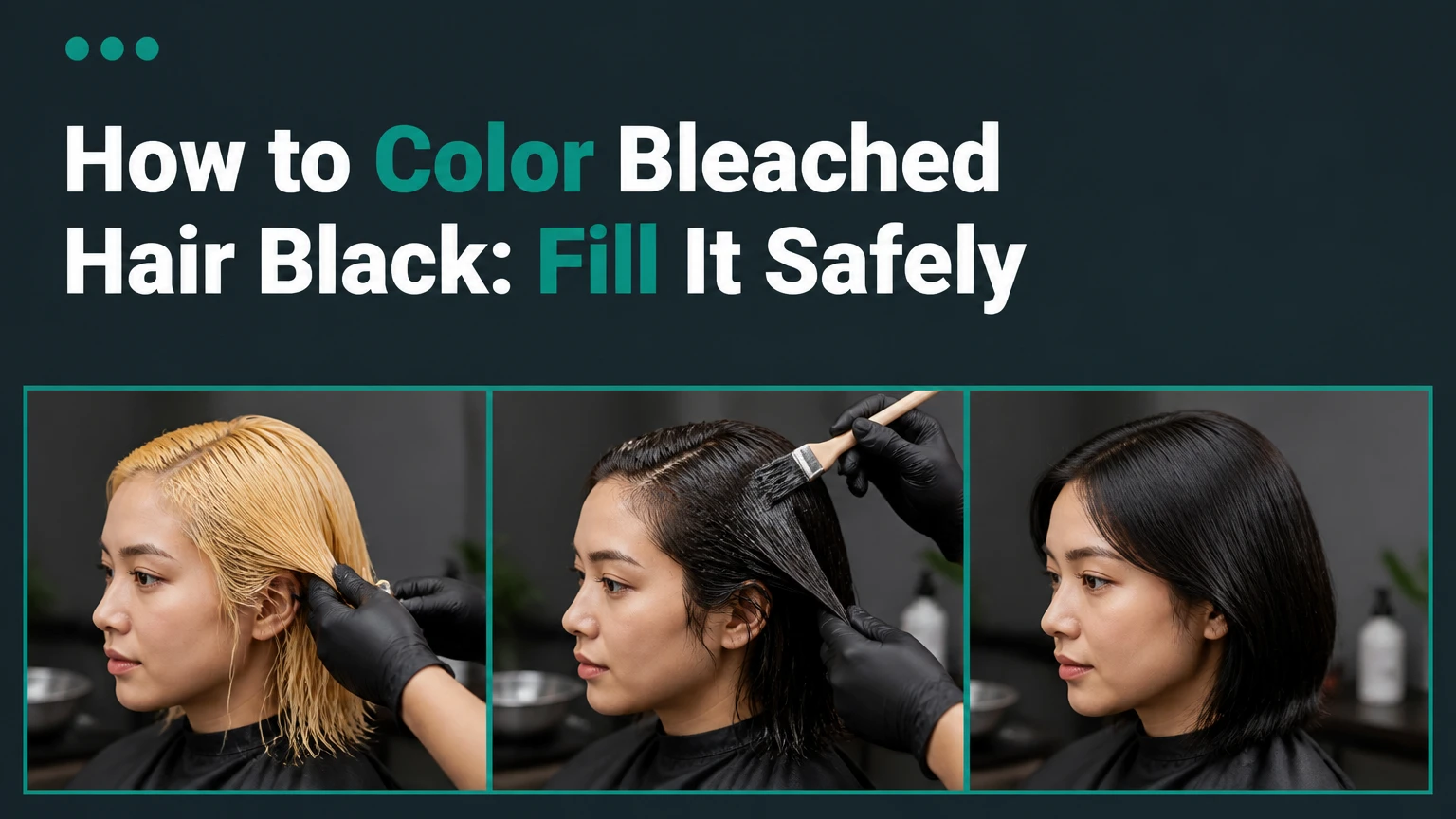
To color bleached hair black, replace the warm pigment removed during lightening before applying the black shade. Apply a copper, red, or red-orange filler suited to the hair’s lightness, process it as directed, then deposit black with controlled saturation and a strand-tested formula.
Key Facts at a Glance
Bleached hair commonly needs a warm filler before black color to prevent green, gray, or hollow results.
Hair below level 7 often needs red-orange or copper warmth, while very pale level 9-10 hair may need stronger red-gold support.
A demi-permanent black is usually easier to reverse than permanent black and places less chemical stress on porous lengths.
Typical home application takes 2-3 hours; a salon appointment commonly takes 2-4 hours.
A strand test and elasticity check matter more than a generic processing time.
Hair electrolysis cannot remove or deposit hair color because electrolysis destroys individual follicles rather than changing the hair shaft.
Why Does Bleached Hair Need Filling Before Black?
Bleached hair needs filling because lightener removes varying amounts of red, orange, and yellow melanin, leaving the strand without the warm foundation that dark color normally relies on. Black dye applied directly to a pale, porous base can look greenish, smoky, gray, or translucent because the cool color molecules have no balanced warm base.
Hair colorists describe this preparation as repigmentation or filling. The filler does not make the hair black; it replaces missing underlying pigment so the final dark color has enough warmth, density, and visual opacity. Hair chemistry references describe bleaching as a process that alters melanin and the fiber structure, which helps explain why porous bleached hair behaves differently from virgin hair.
What Happens If You Skip the Filler?
Skipping the filler increases the risk of a hollow result, especially with blue-black or ash-based formulas. Green appears when a cool blue component meets a base that lacks sufficient red warmth, while gray or khaki results can occur when the final formula is too cool for the degree of pigment loss.
The risk is not identical for every head. A level 7 golden blonde with moderate porosity may accept a neutral dark color more evenly than level 10 platinum hair with fragile ends. Hair porosity, previous dye, uneven bleach, and the target shade all change the formula.
What Should You Do Before Coloring?
Before coloring, perform a patch test, a strand test, an elasticity check, and a porosity assessment. Gather enough product for complete saturation, because underestimating quantity creates patchy black bands that are difficult to correct.
| Preparation item | Typical specification | Why it matters | Stop condition |
|---|---|---|---|
| Strand test | 1-2 cm hidden section | Predicts tone, absorption, and timing | Result looks green, gray, or brittle |
| Patch test | 48 hours before use | Screens for allergic reaction | Itching, swelling, rash, or burning |
| Elasticity check | Hair stretches slightly and returns | Indicates usable structural strength | Wet hair stretches excessively or snaps |
| Hair condition | Dry but not dripping wet | Prevents diluted, uneven deposit | Hair feels gummy or mushy |
| Product quantity | 1 box for short hair, 2 for shoulder length | Ensures full saturation | Less than one full application remains |
| Gloves and clips | 1 pair of gloves, 4-8 clips | Protects hands and controls sections | Missing protective equipment |
Hair that feels gummy when wet, snaps during gentle stretching, or has white, split ends should not receive an aggressive permanent color at home. A dark deposit may hide damage temporarily, but it cannot rebuild a compromised cortex.
Do not apply color over an irritated scalp. Avoid combining unknown metallic-dye history, henna containing metallic salts, relaxers, or incompatible chemical services without professional evaluation. Product labels govern the exact allergy test, mixing ratio, developer, and timing.
Which Filler Matches Your Bleached Hair?
The appropriate filler depends primarily on the starting level, not on the word “blonde” alone. Very pale hair generally needs more red or red-gold support, while darker blonde hair usually needs copper or red-orange support before a black deposit.
| Starting hair level | Visible underlying pigment | Typical filler family | Typical processing range |
|---|---|---|---|
| Level 6 dark blonde | Red-orange and orange | Copper-red | 10-20 minutes |
| Level 7 medium blonde | Orange and yellow-orange | Copper or red-orange | 10-20 minutes |
| Level 8 light blonde | Yellow-orange and yellow | Gold-copper or red-gold | 10-20 minutes |
| Level 9 very light blonde | Yellow | Gold-red or red-gold | 10-20 minutes |
| Level 10 platinum | Pale yellow or nearly absent warmth | Red-gold, warm protein filler | 10-20 minutes |
A filler one to two levels lighter than the intended black target is a common professional starting principle, but shade numbering differs among brands. A tube labeled 6R, 7RR, copper, or warm protein filler may behave differently because the color system, pigment concentration, and activator are not standardized across manufacturers.
How Much Warmth Is Enough?
Enough warmth is present when the strand looks evenly warm and saturated but not dark brown before the final color. The filler should restore a believable base, not create a bright, visible red layer that competes with the black.
Highly porous ends often absorb filler faster than roots. Apply to the least porous areas first when the instructions allow, then distribute through fragile ends later. If the manufacturer requires one application from roots to ends, follow that direction and reduce overlap on already saturated sections.
Step-by-Step: How to Color Bleached Hair Black
The safest general sequence is: test the hair, apply a warm filler, rinse and dry according to the product directions, apply black color, then condition and limit early fading. Typical total time is 2-3 hours at home, including sectioning, filler processing, drying, final color processing, and rinsing.
Step 1: Select the Final Black Shade
Choose neutral black for the most balanced result, soft black for a less severe appearance, or blue-black only when the filled base is sufficiently warm and the desired result is visibly cool. Black color is difficult to remove, so a demi-permanent formula is often the prudent first attempt on previously bleached lengths.
| Final shade | Visual result | Best starting base | Main risk |
|---|---|---|---|
| Neutral black | Balanced black with limited blue or red | Filled level 6-10 blonde | Can look dense on porous ends |
| Soft black | Slightly lighter, less severe black | Warm-filled blonde | May fade faster than permanent black |
| Blue-black | Cool black with blue reflection | Thoroughly warm-filled blonde | Green, teal, or smoky cast |
| Brown-black | Black-brown appearance | Copper-filled level 6-9 hair | Can appear warmer than expected |
| Demi black | Deposit-focused, gradual fade | Healthy to moderately porous hair | Uneven fade on porous sections |
Do not use blue-black to cancel orange before filling. Blue can neutralize orange in a toning context, but the same cool balance can become green or gray when the hair lacks enough red foundation.
Step 2: Section and Apply the Filler
Divide dry or towel-dried hair into four quadrants, then make narrow subsections approximately 0.5-1 centimeter wide. Apply the filler with a tint brush from the most resistant areas toward the most porous areas, fully saturating each subsection without repeatedly brushing product through the ends.
Use the developer, mixing ratio, and processing time printed by the filler manufacturer. Ten-volume developer is common for deposit-oriented professional formulas, but some fillers are direct dyes, masks, or protein products that require no developer. Never substitute developer by volume merely because a general guide recommends it.
Success checkpoint: The hair looks evenly coated and consistently warm, with no dry pale patches.
Common mistake: Applying a thin film of filler to thick hair, then assuming the section is saturated.
Step 3: Process, Rinse, and Assess the Filled Hair
Process the filler for the label time, commonly 10-20 minutes, and inspect the strand test before rinsing the whole head. Rinse according to the product directions, remove excess water, and dry the hair completely if the final color requires a dry application.
Do not shampoo automatically between steps. Some systems require a rinse only, while others specify shampoo or conditioner. Product chemistry differs, and unnecessary washing can remove freshly deposited pigment before the black color is applied.
Success checkpoint: The strand looks warm, even, and opaque enough to support the final shade.
Common mistake: Applying black over a filler that is patchy, dripping wet, or visibly absent on the ends.
Step 4: Apply the Black Color
Apply black color in the same four-quadrant pattern, beginning where the hair is least porous and keeping the most fragile ends under close observation. Use enough product to make every subsection visibly saturated, but avoid repeatedly overlapping permanent color onto already darkened lengths.
Typical black color processing takes 20-45 minutes, but the label instructions override that range. A permanent formula may use 10- or 20-volume developer, while demi-permanent color uses its designated low-volume activator. Semi-permanent direct dye generally uses no developer.
Success checkpoint: Every strand is covered, and the product remains moist throughout processing.
Common mistake: Rubbing the product into the ends first, which can create ink-black tips and a lighter crown.
Step 5: Rinse and Condition
Rinse with lukewarm or cool water until the runoff is substantially clear, then use the post-color conditioner specified by the manufacturer. Leave the conditioner on for the label time, commonly 5-10 minutes, and avoid aggressive towel rubbing.
Waiting 48-72 hours before the first shampoo is a practical way to reduce early color loss, although not every modern formula requires a fixed 72-hour delay. Use the product instructions as the controlling authority, especially when the color system includes a dedicated acidic cleanser.
Success checkpoint: The hair feels flexible rather than gummy, and the color looks even in natural light.
Common mistake: Using hot water, a clarifying shampoo, or a vigorous scalp scrub immediately after coloring.
Which Black Dye Type Is Best for Bleached Hair?
Demi-permanent black is usually the best first choice for bleached hair that is structurally sound but porous, because it deposits substantial color with less commitment than permanent dye. Semi-permanent color suits temporary changes, while permanent color offers the strongest durability but creates the most difficult removal problem.
| Color type | Developer requirement | Typical durability | Damage and reversibility |
|---|---|---|---|
| Semi-permanent direct dye | None | 4-15 shampoos | Lowest chemical stress, easiest to change |
| Demi-permanent | Brand activator, often low volume | 20-28 shampoos | Moderate commitment, limited lift |
| Permanent | Commonly 10-20 volume | 4-8 weeks at roots | Highest commitment, difficult removal |
| Color-depositing mask | None | 2-8 shampoos | Low stress, weaker opacity |
| Salon acidic demi | Dedicated activator | 4-6 weeks | Glossy deposit, professional formulation |
Longevity depends on porosity, washing frequency, water temperature, heat styling, ultraviolet exposure, and the shade’s pigment balance. The often-repeated claim that demi color always lasts exactly 24 washes is too precise; manufacturers and hair condition produce different results.
Why Can Permanent Black Be a Poor Choice?
Permanent black is a poor first choice when the person may want blonde, vivid color, highlights, or a lighter brown within the next year. Artificial black pigment does not simply lift away with bleach, and repeated corrective lightening can expose uneven red, orange, and banded sections.
Permanent color may be reasonable for a stable long-term black result, healthy hair, and professional application. It remains a commitment, not a neutral maintenance choice.
How Much Time and Money Should You Expect?
A typical home service takes 2-3 hours and costs approximately $20-$70 for filler, color, developer, gloves, and conditioner. A salon service commonly takes 2-4 hours and costs roughly $100-$300 in the United States, with regional labor rates, hair density, corrective work, and product quantity causing large differences.
| Service scenario | Typical time | Typical US cost | Main cost driver |
|---|---|---|---|
| Short, evenly bleached DIY hair | 2-2.5 hours | $20-$45 | One color kit and one filler |
| Long or thick DIY hair | 2.5-4 hours | $40-$90 | Two or more color kits |
| Salon virgin darkening service | 2-3 hours | $100-$200 | Labor and formulation |
| Salon corrective fill and black | 3-5 hours | $175-$400 | Porosity, banding, and multiple formulas |
| Root touch-up after initial service | 1.5-2.5 hours | $60-$160 | Regrowth and length refresh |
Prices are typical planning ranges, not universal price quotes. A salon may charge more when the hair has overlapping bleach, previous fashion color, severe porosity, or enough length to require several bowls of product.
How Should You Care for Newly Blackened Bleached Hair?
Newly blackened bleached hair retains color best with infrequent washing, lukewarm water, a color-safe cleanser, regular conditioning, and low heat. Color care cannot reverse bleach damage, but it can reduce swelling, friction, and the rapid release of deposited pigment.
| Care variable | Better target | Fading trigger | Practical adjustment |
|---|---|---|---|
| Shampoo frequency | 2-3 times weekly | Daily cleansing | Use dry shampoo between washes |
| Water temperature | Lukewarm, below hot | Hot showers | Rinse cooler at the end |
| Heat tools | Below 180°C when possible | High heat without protectant | Apply thermal protection |
| Swimming | Wet hair and use a cap | Chlorinated or salt water | Rinse immediately afterward |
| Conditioning | Every wash, mask weekly | Skipping conditioning | Use a silicone or lipid-based conditioner |
| Clarifying cleanser | Every 3-6 weeks, if needed | Weekly clarifying | Reserve for buildup emergencies |
A protein treatment can improve feel temporarily, but frequent protein use may make some bleached hair rigid or rough. Alternate strengthening products with moisturizing conditioners and judge the result by elasticity, softness, and breakage rather than by the product label alone.
What Causes Green, Gray, Faded, or Patchy Black Hair?
Green or gray black hair usually indicates an undertone imbalance, while rapid fading usually indicates high porosity, insufficient saturation, aggressive cleansing, or an unsuitable color system. Patchiness usually begins with uneven bleach or unequal product distribution, so adding another full layer of black can make the correction harder.
| Visible problem | Likely cause | First response | Avoid |
|---|---|---|---|
| Green or khaki cast | Too little red warmth | Stop and consult a colorist or use a tested red deposit | Adding blue-black |
| Smoky gray result | Excess cool pigment on pale hair | Add controlled warm deposit after strand testing | Applying permanent black immediately |
| Orange-brown result | Filler or final formula too warm | Reassess in daylight before toning | Using strong blue without a test |
| Pale or faded ends | High porosity and poor retention | Refresh with demi or direct deposit | Repeated permanent overlap |
| Dark ink-black ends | Ends absorbed excess color | Avoid further overlap; seek corrective advice | Bleaching fragile ends at home |
| Horizontal bands | Uneven previous bleach | Map the bands before recoloring | Treating the whole head identically |
How Do You Fix Green Hair After Black Dye?
Fix green hair after black dye by stopping further cool pigment and having the color assessed before applying a controlled red or red-orange deposit. A semi-permanent red product may correct a mild cast, but a strong green result, uneven bands, or fragile hair requires professional color correction rather than repeated home applications.
Color-depositing red shampoo can provide a temporary adjustment, but it is not a reliable substitute for a properly formulated filler. Apply any corrective product to a strand first, because porous hair can absorb red unevenly and become purple, burgundy, or visibly warm.
What If the Color Fades After One Week?
If black color fades after one week, the most likely causes are high porosity, inadequate saturation, frequent cleansing, hot water, or a direct dye that was not compatible with the hair’s condition. Refill only the faded areas after a strand test, and use a demi-permanent gloss or deposit mask rather than repeatedly applying permanent color.
A protein filler may help some porous hair hold pigment, but it cannot repair cuticle loss permanently. If the hair remains rough, stretchy, or fragile, improve its condition before recoloring.
What Changes for Different Hair Situations?
Very damaged hair should receive a professional assessment, while healthy, evenly bleached hair can often accept a carefully strand-tested deposit at home. Natural dark roots, curly textures, extensions, and previous fashion colors each require different application boundaries and product checks.
| Situation | Safer approach | Formula preference | Professional threshold |
|---|---|---|---|
| Level 10 platinum hair | Stronger warm repigmentation | Demi black after red-gold fill | Breakage or gummy elasticity |
| Dark natural roots with blonde lengths | Apply different formulas by zone | Deposit on lengths, root formula only if needed | Banding or more than 2 levels difference |
| Curly or coily bleached hair | Preserve moisture and reduce manipulation | Demi or direct deposit | Dryness, snapping, or uneven porosity |
| Tape-in or bonded extensions | Check extension-maker instructions | Often deposit-only products | Any uncertainty about bond compatibility |
| Previous vivid dye | Test for color interactions | Separate correction from blackening | Staining, metallic salts, or unknown history |
Hair extensions may not tolerate the same peroxide, heat, or processing time as natural hair. Remove or isolate extensions only according to the manufacturer’s instructions, and never assume a human-hair extension has the same porosity as the wearer’s hair.
Can You Return to Blonde After Coloring Hair Black?
Returning to blonde after black color is possible but unpredictable, particularly after permanent black or repeated dark applications. A color remover may reduce some artificial pigment, but it does not restore natural melanin and may reveal red, orange, or uneven underlying lightness.
Plan black as a long-term decision if the hair was previously bleached. A professional may need several appointments with bond protection, test strands, trims, and intermediate brunette stages. Do not bleach black color immediately at home when the hair already shows breakage.
Is Hair Electrolysis Relevant to Bleached Hair Color?
Hair electrolysis is not relevant to coloring bleached hair black because electrolysis treats the follicle beneath the skin, while hair color changes pigment inside or around the visible hair shaft. Electrolysis cannot fill, darken, strip, or correct black dye.
The distinction matters when people use “hair removal” terminology while researching hair treatments. Electrolysis uses a probe and electrical current for follicle destruction; hair dye uses oxidative or direct pigments on the fiber. These procedures should never be combined or presented as alternatives.
Common Mistakes and How to Fix Them
The most damaging mistakes are skipping the filler, choosing a cool black for an unfilled pale base, using excessive developer, and overlapping permanent color onto porous ends. Corrective work should reduce chemical exposure, isolate the problem, and rely on strand tests instead of applying stronger product everywhere.
- Skipping the filler: Remove the risk by applying a warm repigmentation step before black.
- Using 30-volume developer: Do not use high-volume developer to make a deposit darker; follow the color system’s specified activator.
- Applying one formula to every zone: Separate resistant roots, filled mids, and porous ends when their needs differ.
- Leaving color on longer for extra darkness: Longer processing does not reliably fix missing warmth or uneven saturation.
- Shampooing aggressively after coloring: Use a gentle color-safe cleanser and cooler water.
- Trying to bleach out unwanted black immediately: Wait for a professional assessment if the hair is fragile or the color is permanent.
A practitioner rule of thumb is simple: porous hair needs more control, not more force. Stronger peroxide, extra processing, and repeated overlap usually increase damage faster than they improve evenness.
Frequently Asked Questions
Can I Put Black Dye Directly on Bleached Hair?
You can physically apply black dye directly to bleached hair, but the result is less predictable without warm repigmentation. Direct application may work with some deposit-only neutral formulas on moderately warm level 7-8 hair, yet pale or highly porous hair has a higher risk of green, gray, hollow, or uneven color.
Should I Use Black Box Dye on Bleached Hair?
Black box dye can darken bleached hair, but its fixed formula makes it harder to adapt to uneven porosity, pale ends, and different root conditions. A professional or salon color line gives more control over filler, developer, shade family, and placement, while demi-permanent color offers a less permanent first attempt.
Is Semi-Permanent Black Safer Than Permanent Black?
Semi-permanent black generally creates less chemical stress because it contains no oxidative developer, making it a reasonable option for fragile hair. It can still stain porous hair, bleed onto fabrics, and fade unevenly, so “less chemical stress” does not mean guaranteed damage-free or completely removable color.
How Often Should Black Hair Color Be Touched Up?
Most black color touch-ups occur every 4-8 weeks, depending on visible root growth and the chosen formula. Refresh the lengths only when they have faded, because repeatedly applying permanent black over already dark porous hair can create excessive buildup and make future lightening much more difficult.
Can I Dye Bleached Hair Black Without Developer?
You can use a semi-permanent direct dye or color-depositing mask without developer, but permanent and many demi-permanent formulas require their specified activator. A no-developer product may be gentler, yet it may provide less opacity and durability, especially on unevenly bleached or very porous hair.
The Bottom Line
Coloring bleached hair black works best when the missing warm foundation is replaced before the dark pigment is deposited. Choose the filler by starting level, use a strand test to control warmth and absorption, prefer demi or direct color when reversibility matters, and reserve permanent black for hair that is healthy enough and unlikely to be lightened again. The correct sequence is the difference between dense, balanced black and a hollow green-gray result.