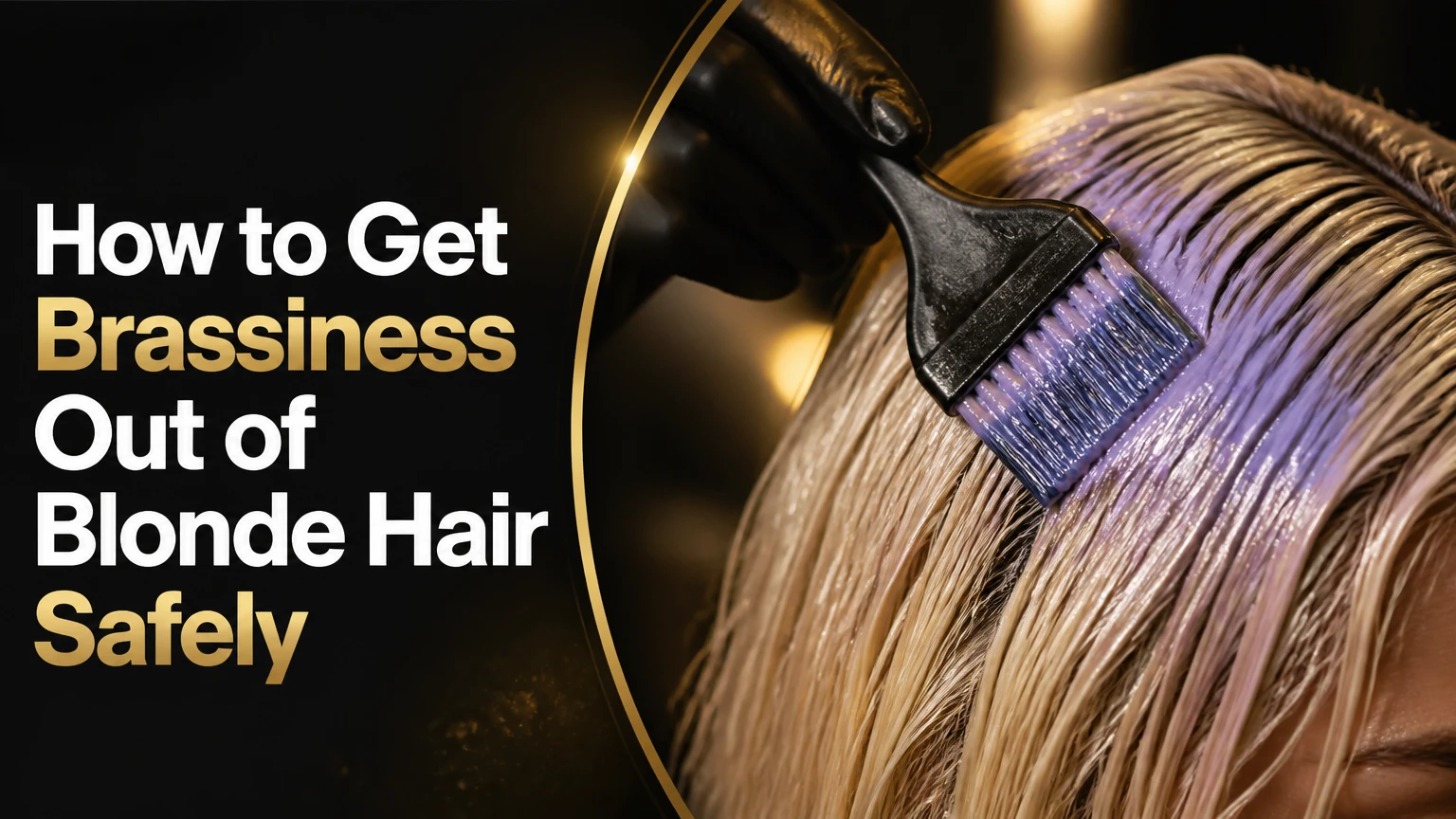
To get brassiness out of blonde hair, first identify whether the unwanted tone is yellow, orange, or red, then use the complementary violet, blue, or blue-green pigment. Mild brassiness usually responds to a toning shampoo, while strong warmth, mineral buildup, uneven roots, or damaged hair may require a chelating treatment or professional toner.
Key Facts at a Glance
- Purple pigment neutralizes yellow; blue pigment neutralizes orange; blue-green pigment can moderate red-orange warmth.
- Toning deposits or masks complementary pigment, but toner cannot make hair lighter.
- Orange hair often indicates that the hair has not reached a light enough level for a pale blonde result.
- Porous ends absorb purple and blue pigment faster than healthy roots, so uneven application can create gray or muddy patches.
- Hard-water minerals, especially iron and copper, can create warmth that shampoo alone does not remove.
- A strand test is the safest way to determine processing time on bleached or highly porous hair.
What Does Brassiness Mean?
Brassiness is unwanted yellow, orange, or red warmth visible in lightened or blonde hair. Bleaching removes natural melanin in stages, exposing underlying warm pigments; when an ash toner or gloss fades, those pigments become visible again. L’Oréal Paris describes this resurfacing process as a common result of color fading and underlying pigment exposure.
Hair colorists assess warmth by the hair’s level, not by the word “blonde” alone. Dark blonde and light brown hair commonly expose orange, medium blonde can expose yellow-orange, and pale blonde usually exposes yellow. The starting color, lightener formula, processing time, previous dye, and hair porosity all influence the result.
Brassiness also has environmental causes. Iron and copper in water can adhere to porous hair and alter its reflection, while ultraviolet exposure, chlorine, frequent washing, and high heat can accelerate the loss of cool pigment. A water filter can reduce exposure, but an existing mineral deposit may need a chelating treatment.
Brassiness Versus an Unwanted Color Result
Brassiness is warm underlying pigment, but every unwanted blonde result is not brassiness. Green hair after swimming usually involves copper interacting with a yellow base, while dull gray or purple hair usually means excess cool pigment on porous strands. Brown bands, banding, and bright roots indicate an application or lifting problem rather than a simple maintenance issue.
Which Pigment Cancels the Warmth?
The correct neutralizing pigment depends on the visible undertone: violet for yellow, blue for orange, and blue-green for red-orange. The color wheel explains the direction, but the formula must also match the hair’s depth and porosity. Purple shampoo cannot reliably correct deep orange hair because violet does not neutralize orange strongly enough.
| Visible warmth | Typical underlying level | Corrective pigment | Suitable first option |
|---|---|---|---|
| Pale lemon yellow | Level 9-10 | Violet or violet-blue | Purple shampoo or violet gloss |
| Golden yellow | Level 8-9 | Violet with a small blue component | Purple conditioner or salon toner |
| Yellow-orange | Level 7-8 | Blue-violet | Blue shampoo or demi-permanent toner |
| Clear orange | Level 6-7 | Blue | Blue shampoo or blue-based toner |
| Red-orange | Level 5-6 | Blue-green | Professional color correction |
Color theory gives direction, not a complete formula. A very porous level-10 end may need less pigment than a resistant level-8 root, even when both appear yellow-orange. Applying one strong product uniformly to both zones can leave the ends smoky while the roots remain warm.
How Can You Diagnose the Undertone?
Wash away styling residue, examine the hair in indirect natural light, and compare the warm area with a neutral white sheet. Yellow resembles lemon or straw, orange resembles copper or pumpkin, and red-orange resembles auburn or rust. Take a photograph without a warm indoor filter because artificial lighting can misclassify yellow as beige or orange.
How to Get Brassiness Out of Blonde Hair at Home
A safe home process has five stages: remove surface buildup, select the matching pigment, test a small section, apply to the warmest areas, and condition after rinsing. Mild yellow usually takes 5-10 minutes with a toning cleanser, while severe or uneven brassiness should not be treated repeatedly with stronger products.
Step 1: Remove Buildup Before Toning
Use a gentle clarifying shampoo once if the hair contains dry shampoo, oil, heavy silicone styling products, or visible residue. Rinse thoroughly and blot with a towel until the hair is damp, because saturated hair dilutes the product and dry porous hair can grab pigment too quickly.
Do not clarify repeatedly on fragile bleached hair. A clarifying wash removes some temporary color and buildup, but it does not remove permanent dye, lighten orange hair, or dissolve every mineral deposit. If the hair feels rough, metallic, or unusually coated after washing, use a product labeled chelating or hard-water treatment according to its instructions.
Success checkpoint: Hair feels clean but not squeaky, and water spreads evenly through the strands.
Common mistake: Applying purple shampoo over oil or styling buildup, which creates patchy pigment deposition.
Step 2: Choose Purple or Blue Shampoo
Choose purple shampoo for yellow warmth and blue shampoo for orange warmth. Apply the product to clean, damp hair, distribute it with gloved hands, and begin with the manufacturer’s shortest recommended processing time, usually 1-5 minutes.
Apply first to the warmest area rather than automatically starting at the roots. Check the hair every minute under neutral light. Porous ends may need only 30-60 seconds, while resistant mid-lengths may need the full label time.
| Product type | Best undertone | Typical processing time | Typical result duration | Typical cost |
|---|---|---|---|---|
| Purple shampoo | Pale yellow, level 9-10 | 1-5 minutes | 1-2 washes | $10-$38 |
| Purple conditioner | Yellow on dry, porous ends | 2-10 minutes | 2-4 washes | $12-$40 |
| Blue shampoo | Orange, level 7-8 | 1-5 minutes | 1-2 washes | $10-$35 |
| Toning foam or leave-in | Mild warmth during styling | No rinse, label-directed | Until next wash | $15-$40 |
Rinse with cool or lukewarm water, then apply a moisturizing conditioner. Toning shampoo is a temporary maintenance product, not a lightener or permanent correction. Start once weekly, or once every three washes, and increase only if the color consistently returns before the next wash.
Success checkpoint: Warmth looks softer without purple, blue, gray, or muddy areas.
Common mistake: Leaving shampoo on for 10-20 minutes because a short application did not produce an immediate dramatic change.
Step 3: Use a Demi-Permanent Toner for Persistent Warmth
Use a demi-permanent toner when shampoo is too weak, the warmth is uneven, or the desired result must last several weeks. Demi-permanent formulas deposit color with low-volume developer and generally do not provide the substantial lift required to turn orange hair into pale blonde.
At-home toner is safer when the product is a complete kit with a matched developer. Do not improvise a salon formula by mixing unrelated color brands, changing the developer strength, or guessing a ratio. Professional products vary: some use acidic activators, while others use 6-volume or 10-volume developer, so the label formula controls.
Perform a patch test and a strand test according to the product instructions. Separate hair into four sections, apply quickly to the warmest zones, and monitor visually. Keep the product away from already-ash blonde ends unless the strand test shows that those ends need toning.
Success checkpoint: The test strand becomes neutral or softly cool without becoming gray or darker.
Common mistake: Pulling a root toner through porous ends for the entire processing period, which can create banding and over-deposit.
Step 4: Book a Salon Toner When the Problem Is Structural
A salon toner or gloss is the fastest controlled option for severe brassiness, uneven bands, hot roots, or hair with multiple previous color services. A stylist can choose different formulas for the roots, mid-lengths, and ends, then stop processing when each zone reaches the intended reflection.
A toner cannot correct hair that is fundamentally too dark for the target blonde. If the hair is level 7 orange but the goal is level 10 platinum, the service may require additional lightening, and repeated bleaching at home creates a substantial breakage risk. Colorists commonly use a demi-permanent gloss after lightening to refine tone rather than force all correction through shampoo.
Success checkpoint: Warmth is balanced across zones, with no bright root band or smoky ends.
Common mistake: Requesting “ash” without showing a reference image or explaining whether the desired result is beige, neutral, golden, or icy.
Step 5: Treat Mineral Buildup and Prevent Its Return
Use a chelating treatment when brassiness returns immediately after washing, appears more orange after hard-water exposure, or accompanies rough, coated-feeling hair. Hard-water products may contain ingredients designed to bind minerals, whereas an ordinary clarifying shampoo mainly removes cosmetic residue.
A shower filter can reduce some sediment and certain water contaminants, but not every filter removes dissolved iron or copper. Check the filter’s specifications and replace cartridges on the manufacturer’s schedule, often around six months. A filter prevents exposure; it does not reverse existing discoloration by itself.
| Cause | Diagnostic clue | First treatment | Maintenance interval |
|---|---|---|---|
| Faded toner | Warmth returns gradually over 3-6 weeks | Demi gloss or toning shampoo | Shampoo weekly; gloss 4-6 weeks |
| Product buildup | Hair feels coated and color looks dull | Clarifying shampoo | Every 2-4 weeks if needed |
| Iron or copper deposits | Rough hair and fast orange shift after washing | Chelating treatment | Product-directed, often monthly |
| Pool chlorine | Green or khaki cast after swimming | Chelating swimmer treatment | After pool exposure |
| UV and heat | Ends fade faster and feel dry | UV protection and heat protectant | Every outdoor or heat session |
Product Comparison: Which Method Fits Your Hair?
Purple shampoo is the most economical choice for mild yellowing, while a blue shampoo fits orange warmth on darker blonde hair. A demi-permanent toner lasts longer and offers more control, but the application carries greater risk on uneven or porous hair. Chelating treatment addresses mineral buildup, not ordinary fading.
| Method | Best shade situation | Processing or service time | Typical longevity | Typical cost |
|---|---|---|---|---|
| Purple shampoo | Level 9-10 yellow | 1-5 minutes | 1-2 washes | $10-$38 |
| Blue shampoo | Level 7-8 orange | 1-5 minutes | 1-2 washes | $10-$35 |
| At-home gloss kit | Moderate, fairly even warmth | 10-20 minutes | 3-6 weeks | $15-$35 |
| Salon toner or gloss | Severe or uneven warmth | 30-60 minutes total | 4-6 weeks | $40-$120+ |
| Chelating treatment | Iron, copper, or hard-water buildup | 5-20 minutes | Depends on water exposure | $15-$45 |
| Shower filter | Ongoing mineral prevention | 15-30 minutes to install | Cartridge-dependent | $35-$90 |
What Is the Fastest Way to Remove Brassiness?
A salon toner is usually the fastest predictable correction because the stylist can match pigment to each section and monitor the result. For mild, even yellowing, a purple shampoo can soften warmth in one wash. Neither option can safely replace lightening when the hair remains several levels too dark.
Common Mistakes and How to Fix Them
Purple Shampoo Made the Hair Purple or Gray
Stop toning and wash once with a regular shampoo. If the tint remains, use a clarifying wash once, condition thoroughly, and wait before applying more pigment. Avoid aggressive baking-soda mixtures, which can increase dryness and roughness without providing controlled color removal.
Porous hair absorbs direct dye faster than compact hair. The ends often need a shorter application time, diluted conditioner, or no toning product during every wash.
Purple Shampoo Did Nothing
Purple shampoo did not work because the hair may be orange rather than yellow, the product may be too weak, or mineral buildup may block an even result. Switch to blue only when the visible warmth is orange, and use a chelating treatment first if the hair feels coated or the issue began after a water change.
Do not layer purple shampoo, blue shampoo, toner, and bleach in one day. Multiple corrective products can make diagnosis harder and increase dryness.
Roots Are Orange but Ends Are Cool
Bright orange roots with ash-blonde ends usually indicate uneven lift or a hot-root effect, not a need for more purple shampoo on the whole head. Spot-treating the roots with a professionally selected blue-based formula is safer than saturating already-cool ends.
Heat from the scalp can accelerate chemical processing near the roots, but a root band can also result from insufficient lightener, overlapping applications, or different starting colors. A stylist should assess the band before another chemical service.
Blonde Looks Green After Swimming
Green or khaki blonde hair usually needs mineral removal rather than purple pigment. Rinse hair with fresh water before swimming, apply a leave-in conditioner, wear a cap when practical, and use a swimmer’s chelating product after exposure.
Do not apply red dye as a blind correction. A small amount of warm filler may be appropriate in professional color correction, but the wrong concentration can create pink or muddy hair.
Situation Variations
How Do You Fix Brassiness on Platinum Hair?
Use the least concentrated violet product that corrects the yellow, and apply it briefly to the most yellow areas. Platinum hair is often highly porous, so a strong purple shampoo can create a lavender or gray cast within minutes. An acidic salon gloss can provide more even refinement when the tone is patchy.
Platinum hair cannot tolerate endless bleaching to maintain coolness. If the hair feels gummy when wet, stretches unusually far, or snaps during detangling, postpone chemical toning and prioritize professional assessment.
How Do You Tone Brassy Highlights in Brown Hair?
Use blue shampoo or a blue-based gloss on orange highlights, while keeping the natural brown base from unnecessary exposure. Purple shampoo is better suited to pale yellow highlights and may produce little visible change on copper-toned pieces.
Apply product selectively with a brush or comb when the highlights are isolated. Whole-head application can make brown hair look dull even if the blonde sections improve.
Can You Tone Damaged or Chemically Treated Hair?
You can sometimes use a temporary toning conditioner on damaged hair, but porous or elastic hair requires a strand test before any oxidative toner. Avoid at-home developer products when the hair is breaking, gummy, recently relaxed, or chemically incompatible with the proposed color service.
Bond-building and conditioning treatments improve manageability, but they do not repair every structural break in the fiber. A treatment cannot make unsafe bleaching safe.
When Should You Stop DIY Toning?
Stop home correction when the hair has overlapping color bands, severe breakage, black or dark permanent dye beneath the blonde, scalp irritation, or a target shade more than one level lighter than the current hair. Professional color correction is also the safer choice after two unsuccessful chemical attempts.
Do not apply color over an active allergic reaction. Follow the product’s patch-test instructions, wear gloves, protect clothing and surfaces, and keep developer away from the eyes and broken skin. Hair color safety instructions vary by product, so the package directions take precedence over generic timing advice.
How Much Does Brassiness Correction Cost?
Typical home correction costs $10-$45 for shampoo, conditioner, or chelating products. A salon toner or gloss commonly costs $40-$120 or more, depending on location, stylist, hair density, and whether the service includes a blow-dry or corrective work. Full lightening and color correction cost substantially more than a maintenance gloss.
| Service or purchase | Typical price range | Typical duration | Suitable use |
|---|---|---|---|
| Toning shampoo | $10-$38 | 1-5 minutes | Mild recurring warmth |
| Chelating treatment | $15-$45 | 5-20 minutes | Mineral buildup |
| Home gloss kit | $15-$35 | 30-60 minutes total | Even moderate brass |
| Salon toner | $40-$120+ | 30-60 minutes | Customized tone |
| Full color correction | $150-$500+ | 3-8 hours | Banding or major mismatch |
Prices vary by country and salon market. Ask whether the quote includes lightening, toner, bond protection, and a finishing service, because a “toner appointment” may not include correction of dark or uneven sections.
How Do You Prevent Blonde Hair From Turning Brassy?
Wash less frequently when practical, use a color-safe cleanser, rinse with lukewarm water, and reserve purple or blue products for scheduled maintenance rather than daily use. Protect hair from ultraviolet exposure, apply heat protectant before hot tools, and rinse immediately after pool or ocean exposure.
Use a chelating treatment when water minerals are the confirmed cause, but do not use it every wash unless the product specifically permits that frequency. A shower filter can reduce exposure, while a whole-home water test or professional water report can identify iron and copper more accurately than guesswork.
A useful maintenance schedule for many blondes is one toning wash every one to three weeks, one moisturizing mask weekly, and a gloss every four to six weeks when the shade is professionally maintained. Porosity, washing frequency, water quality, and sunlight can shorten or lengthen those intervals.
FAQ
Does baking soda remove brassiness from blonde hair?
Baking soda is not a precise brass-removal treatment. Its alkaline, abrasive action may roughen already-lightened hair and increase dryness, while it does not selectively neutralize yellow or orange pigment. Use a labeled clarifying or chelating product instead, then condition the hair and reassess the undertone.
Can lemon juice remove orange tones from bleached hair?
Lemon juice cannot reliably neutralize orange tones and may increase dryness when combined with sunlight. Orange warmth requires blue pigment or additional controlled lifting, depending on the target level. Apply a professional or product-labeled corrective formula rather than using acidic kitchen ingredients on porous hair.
Should I use purple shampoo on orange hair?
Purple shampoo is usually the wrong first choice for orange hair because violet primarily neutralizes yellow. Blue shampoo or a blue-based toner is more appropriate for orange warmth, although the hair may need additional lightening if the intended result is a much paler blonde.
How often should blonde hair be toned?
Many blondes need toning shampoo every one to three weeks and a demi-permanent gloss every four to six weeks, but those are typical ranges rather than fixed rules. Wash frequency, porosity, water minerals, sun exposure, and the intensity of the target tone determine the correct interval.
Can a toner lighten brassy blonde hair?
A toner can neutralize or deposit color, but it generally cannot lighten substantially. If orange hair is too dark for the desired pale blonde, toner may make the reflection cooler while leaving the underlying depth unchanged. Further lightening should be assessed by a professional to limit breakage.
Why does brassiness return after one wash?
Brassiness can return after one wash when the toner was too weak, the hair has mineral buildup, the underlying pigment is substantially warmer than the target, or the hair is highly porous and loses deposited pigment quickly. Diagnose the cause before repeating toner, because additional pigment may worsen unevenness.
The Bottom Line
To get brassiness out of blonde hair, match the correction to the undertone: violet for yellow, blue for orange, and professional blue-green formulas for red-orange. Start with a short, controlled toning-shampoo application for mild warmth, use chelation for mineral buildup, and choose a salon toner for uneven roots, severe brassiness, or fragile hair. The safest result comes from diagnosis before pigment.