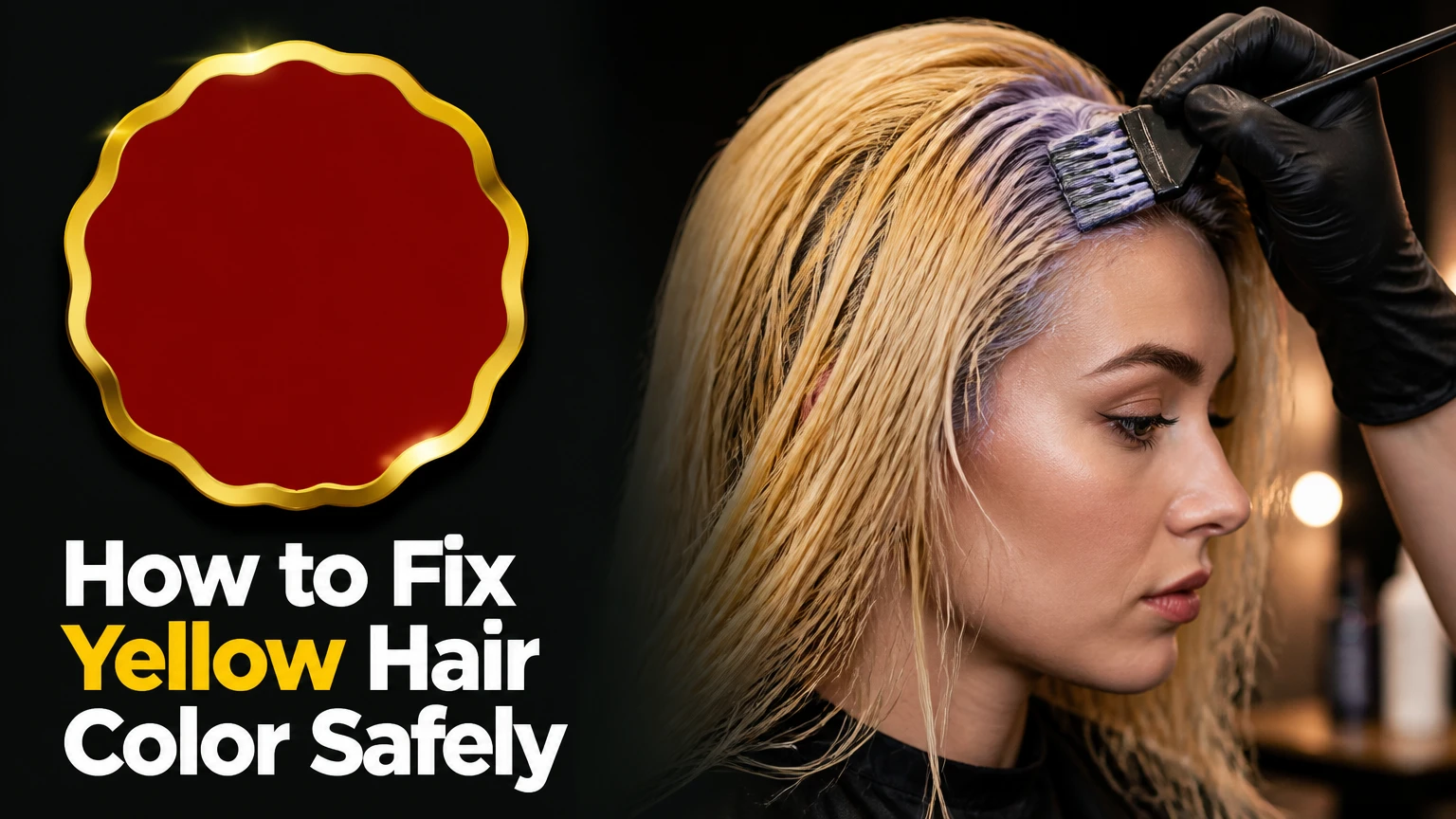
To fix yellow hair color, first identify whether the unwanted warmth is pale yellow, golden yellow, or orange, then choose violet pigment, blue-violet pigment, a toner, or additional lightening accordingly. Purple shampoo maintains a suitable blonde, while a properly matched toner gives stronger correction; neither can make dark yellow hair platinum without lifting.
Key Facts / At a Glance
Violet pigment neutralizes pale yellow; blue pigment is better for orange warmth.
Purple shampoo deposits temporary color and cannot correct dark, uneven yellow bands.
A toner changes tone but does not reliably make hair lighter.
Porous blonde ends absorb violet faster than healthier roots and may turn lavender or gray.
Hair that feels gummy, stretches excessively, snaps, or shows scalp irritation needs professional assessment before more chemical color.
Typical home toning takes 20-45 minutes; salon correction commonly costs $60-$400 or more, depending on the service.
Why Does Hair Turn Yellow?
Yellow hair appears when lightening removes darker melanin first and leaves warmer underlying pigment behind. At approximately level 9, the exposed background is commonly yellow, while level 10 hair usually exposes a paler yellow. Hair can also yellow from product residue, hard-water minerals, heat, smoke, ultraviolet exposure, or oxidation of a cool color. Wella Professionals explains the color-wheel principle directly: “violet is opposite yellow on the colour wheel.”
Hair color levels are a practical diagnosis, not a guarantee. Previous dye, uneven bleach saturation, gray porosity, and artificial pigment can produce several backgrounds on one head. A pale lemon tone may respond to a violet mask, but a banana-yellow level 8 band generally requires more lifting or a darker beige result.
Is Yellow the Same as Brassy Orange?
Yellow, gold, orange, and green require different corrections. Violet counteracts yellow, blue counteracts orange, and a blue-violet formula can address hair containing both yellow and orange. Green usually indicates excessive ash, mineral exposure, or a color interaction rather than insufficient purple shampoo.
| Visible tone | Approximate background | Corrective pigment | Likely result |
|---|---|---|---|
| Pale lemon yellow | Level 9-10 | Violet | Pearl, neutral, or icy blonde |
| Strong golden yellow | Level 8-9 | Violet-gold beige or blue-violet | Beige or cooler dark blonde |
| Orange-yellow | Level 7-8 | Blue-violet | Neutral dark blonde |
| Copper orange | Level 6-7 | Blue | Ash or neutral brown-blonde |
| Green cast | Variable | Chelating treatment or controlled warm correction | Cleaner beige or neutral tone |
Purple shampoo is therefore the wrong first tool for distinctly orange hair. Redken also distinguishes brassy yellow from orange warmth and recommends choosing pigment according to the visible undertone rather than treating every warm blonde identically.
How to Fix Yellow Hair Color at Home
The safest home correction is a deposit-only purple mask or shampoo when the hair is already light enough and the yellow is mild. A dedicated toner can correct stronger yellow, but a developer-based formula requires a strand test, an allergy test according to the product directions, accurate mixing, and strict adherence to the manufacturer’s instructions.
Before You Start
| Requirement | Typical specification | Why it matters |
|---|---|---|
| Total time | 20-45 minutes | Includes washing, application, processing, and rinsing |
| Product cost | $15-$45 for shampoo or mask | Typical retail range, excluding tools |
| Tools | Gloves, plastic bowl, tint brush, clips, timer | Prevents stained hands and uneven application |
| Hair condition | No gummy stretch or active breakage | Fragile cortex may worsen with oxidation |
| Hair test | One hidden strand, 3-10 minute checks | Reveals speed, color depth, and porosity |
| Ventilation | Well-ventilated bathroom or salon | Reduces inhalation and eye exposure risk |
Do not use a generic toner ratio because developer strength and mixing instructions vary between brands. Some direct-dye masks require no developer, while oxidative toners may specify 1:1, 1:2, or another ratio. The package insert controls.
Step 1: Diagnose the Color and Hair Condition
View the hair in neutral daylight after removing temporary styling products. Separate the roots, mid-lengths, and ends, because a yellow root with white porous ends needs different timing and sometimes different formulas.
Stretch one damp strand gently. Healthy wet hair returns close to its original length, while overprocessed hair may stretch like elastic, feel gummy, or break. Do not bleach or use an oxidative toner on hair showing those symptoms.
You will know the diagnosis is useful when you can name both the visible warmth and the darkest section. A common mistake is choosing a level 10 violet toner because the desired result is platinum, even though the existing hair is level 8 yellow.
Step 2: Remove Buildup Without Overstripping
Use a clarifying shampoo if the hair has heavy styling residue, oily buildup, or a dull mineral film. A chelating product is more appropriate when hard water leaves gray, yellow, green, or metallic-looking deposits; ordinary clarifying shampoo does not remove every mineral effectively.
Rinse thoroughly and blot with a towel. Hair should be damp, not dripping, unless the specific product says to apply on dry hair. Highly porous hair can absorb an uneven amount of pigment when product is applied heavily to dry ends.
You will know preparation is adequate when the hair feels clean but not squeaky and water distributes evenly. A common mistake is scrubbing damaged ends aggressively, which increases tangling and makes later pigment absorption less predictable.
Step 3: Perform a Patch Test and Strand Test
Follow the product’s allergy-test directions before using a new oxidative color. Apply the formula to a hidden strand that includes the most yellow and most porous areas, then inspect it at short intervals.
Record the product, developer, ratio, application surface, and processing time. This simple record prevents repeating an over-toning mistake when the same hair absorbs color differently after several washes.
You will know the formula is suitable when the test strand reaches the intended beige, pearl, or neutral result without dryness or a purple-gray cast. A common mistake is testing only a healthy underside while the visible ends are much more porous.
Step 4: Apply Violet Product to the Yellowest Areas
Section the hair into four quadrants. Apply toner or mask to the most yellow, resistant zones first, usually the mid-lengths or freshly lightened bands, and reserve porous white ends for the final few minutes.
Use enough product to saturate each strand without leaving dry gaps. A brush gives better control than rubbing a small amount through the surface, especially when the hair contains horizontal bands.
You will know application is even when every section looks uniformly coated and no dry yellow patches remain. A common mistake is starting with the palest ends because they appear most noticeable; those ends often become violet before the resistant mid-lengths neutralize.
Step 5: Process by Sight and by the Label
Leave the formula on only for the stated time, commonly 2-5 minutes for a purple shampoo, 5-20 minutes for a direct-dye mask, or 10-30 minutes for a toner. Check a strand every few minutes because porous hair can shift rapidly.
A toner is not safer when left longer. Additional time can deepen a gray, violet, or muddy result without removing the underlying yellow. Keep the timer visible and never combine toners from different brands unless a qualified colorist has formulated the mixture.
You will know processing is complete when the yellow is neutralized but the strand still looks luminous and feels flexible. A common mistake is waiting for the hair to look white in the bowl, which can result in a purple deposit on the finished hair.
Step 6: Rinse, Condition, and Reassess
Rinse with cool or lukewarm water until the water runs clear. Apply the recommended post-color conditioner or an acidic, color-safe conditioner, then gently blot rather than twisting the hair.
Judge the result only after the hair is fully dry under neutral light. Wet hair looks darker and cooler than dry hair, and bathroom lighting can make beige hair appear more yellow than it is.
You will know the correction worked when the hair looks more even, the yellow is subdued, and the ends do not appear gray or lavender. A common mistake is applying another round immediately because the wet result seems incomplete.
Which Treatment Fixes Yellow Hair Best?
A purple shampoo is best for mild, recurring yellow; a mask gives stronger temporary deposit; a demi-permanent toner provides more uniform correction; and an acidic gloss gives gentle tone and shine. Re-bleaching is reserved for hair that is too dark or uneven, and it carries the greatest breakage risk.
| Treatment | Pigment and chemistry | Typical duration | Best use |
|---|---|---|---|
| Purple shampoo | Direct violet dyes, surface deposit | 1-2 washes | Mild yellow maintenance |
| Purple mask | Concentrated direct violet dyes | 2-8 washes | Dry or moderately yellow blonde |
| Demi-permanent toner | Oxidative dye with low-volume developer | 4-6 weeks | Strong, uneven yellow after lightening |
| Acidic gloss | Acidic, deposit-focused color formula | 3-6 weeks | Fragile hair needing tone and shine |
| Additional lightening | Persulfate and peroxide | Physical change | Dark yellow or uneven level 8 hair |
Purple Shampoo or Toner?
Choose purple shampoo when the blonde already has the correct lightness and needs periodic maintenance. Choose toner when the hair has strong yellow, inconsistent bands, or a color result that must be controlled more precisely.
Purple shampoo cannot reliably correct dark yellow hair because its pigment load is designed for surface maintenance. Toner also cannot lighten a dark base in the same way bleach does. A toner can make level 8 hair cooler or darker, but it cannot create a level 10 platinum canvas.
| Decision factor | Purple shampoo | Demi-permanent toner | Acidic gloss | Re-lightening |
|---|---|---|---|---|
| Structural lift | 0 levels | Usually 0 levels | 0 levels | Approximately 1-3 levels, formula dependent |
| Developer required | No | Often yes | Product dependent | Yes |
| Typical processing | 2-5 minutes | 10-30 minutes | 10-20 minutes | 20-45 minutes |
| Typical lifespan | 1-2 washes | 4-6 weeks | 3-6 weeks | Until new growth or fading |
| Main risk | Violet buildup | Overprocessing or uneven tone | Limited correction | Breakage and scalp irritation |
Can a Gloss Fix Yellow Hair Without Bleach?
An acidic gloss can soften yellow and add shine without intentionally lifting the hair. Gloss is suitable when the desired result is beige, pearl, or a slightly cooler blonde, but it will not make a level 8 yellow strand become level 10 platinum.
Glosses are particularly useful after repeated bleaching has roughened the cuticle. The trade-off is lower corrective power. A colorist may select a sheer violet, blue-violet, neutral, or beige formula based on the existing level and the client’s target.
What If Purple Shampoo Does Not Work?
Purple shampoo fails when the hair is too dark, the warmth is orange rather than yellow, the hair contains mineral buildup, or the product is too weak or used too briefly. Repeating it more often cannot solve a level mismatch and may leave porous sections dull, gray, or violet.
When Purple Products Fail
- The hair is dark yellow. Use a professional lightening assessment or accept a deeper beige result.
- The hair is orange-yellow. Select a blue-violet formula rather than pure violet.
- The hair is coated with minerals. Use a suitable chelating treatment before toning.
- The hair is banded. Correct each zone separately instead of applying one formula globally.
- The hair is already porous. Reduce processing time and protect pale ends from excessive deposit.
- The target is icy platinum. Confirm that every area has reached the lightness required for that result.
A counterintuitive salon rule is that the most damaged hair often looks the least corrected after toning. Porous ends grab cool dye quickly, creating a smoky or lavender veil, while resistant yellow bands remain visible underneath.
How Do You Fix Common Yellow Hair Problems?
Most yellow-hair problems require correcting the diagnosis before changing the product. Remove excess surface pigment carefully, avoid immediate rebleaching, and use a colorist when the hair’s structure or scalp condition has been compromised.
| Problem | Likely cause | First response | Avoid |
|---|---|---|---|
| Purple or gray ends | Porous hair overabsorbed violet | Wash once with gentle clarifying shampoo | Reapplying purple pigment |
| Orange-yellow bands | Hair is below the violet target level | Use blue-violet guidance or professional correction | Pure purple shampoo alone |
| Yellow returns quickly | Pigment faded, minerals, heat, frequent washing | Reduce hot washing and assess water buildup | Daily purple shampoo |
| Uneven yellow patches | Uneven bleach saturation or application | Zone-specific toner assessment | One strong formula over all hair |
| Greenish blonde | Ash overload or mineral interaction | Stop ash products and seek correction | More blue or purple |
| Hair feels gummy | Severe chemical damage | Stop bleaching and oxidative toning | Heat styling and repeated tests |
If purple buildup is mild, wash with a normal color-safe shampoo and reassess after drying. If the hair is gray, green, or visibly stained, aggressive home color removal can expose a new uneven background, so professional correction is safer.
How Do You Fix Yellow Hair After Bleaching?
After bleaching, use a toner only when the hair has reached the intended lightness and remains structurally sound. If the bleached hair is pale yellow and elastic strength is normal, a violet or blue-violet toner can neutralize it; if the hair is dark yellow, more controlled lifting may be necessary.
Uneven post-bleach hair usually reflects uneven saturation, previous artificial color, heat from the scalp, or different porosity zones. Roots may lift faster because scalp heat accelerates processing, while old ends may be lighter but more porous. A single all-over application can worsen the contrast.
How Do You Fix Yellow Gray or White Hair?
Yellow gray or white hair often responds to a very dilute violet deposit, but gray strands are frequently porous and can turn lavender quickly. Start with a short strand test and use a maintenance product less often than the label’s maximum frequency if the hair grabs pigment.
Yellowing in white hair may come from smoke, minerals, heat, ultraviolet exposure, or product residue rather than incomplete bleaching. A gentle cleansing or chelating step may be more appropriate than a stronger toner.
When Should You Stop DIY Color Correction?
Stop home correction when hair stretches excessively, breaks during detangling, feels gummy when wet, or produces scalp burning, swelling, blistering, or persistent itching. A professional colorist should assess severe banding, dark artificial dye, repeated bleaching, or a platinum target on fragile hair.
Hair color chemistry cannot repair lost structural strength. Bond-building products may improve manageability, but they do not make unsafe additional bleach safe. The practical priority is to stabilize the hair, reduce heat, use conditioner, and schedule a corrective consultation.
Is Toner Safe for Damaged Hair?
Deposit-only masks and some acidic glosses generally impose less chemical stress than rebleaching, but no product is risk-free for severely damaged hair. A toner may still dry the hair, irritate the scalp, or create uneven color when the cuticle is highly porous.
A useful practitioner threshold is simple: if wet hair stretches and fails to return, do not use developer-based toner at home. Ask a colorist about a strand test, a gloss, or a temporary deposit product instead.
How Long Does Yellow Hair Correction Take and Cost?
A home maintenance wash usually takes 5-10 minutes, a toner application takes about 20-45 minutes, and professional corrective bleaching may require 2-5 hours across one or more appointments. Typical costs range from $15-$45 for a retail product, $60-$120 for a gloss, and $150-$400 or more for complex correction.
| Service or product | Typical price | Typical duration | Cost driver |
|---|---|---|---|
| Purple shampoo or mask | $15-$45 | 5-10 minutes | Brand size and pigment concentration |
| Home toner kit | $12-$25 | 20-45 minutes | Developer, tools, and strand testing |
| Salon toner | $50-$100 | 30-60 minutes | Hair length and salon location |
| Acidic gloss | $60-$120 | 45-90 minutes | Formula and styling service |
| Corrective bleach | $150-$400+ | 2-5 hours | Bands, length, density, and damage risk |
These are typical consumer and salon ranges, not guaranteed prices. A colorist may charge more when correction requires several formulas, bond-support steps, a haircut, or a second appointment.
How Do You Maintain a Cooler Blonde?
Maintain a corrected blonde by washing less frequently with lukewarm water, using a color-safe cleanser, limiting high heat, and applying purple pigment only when yellow becomes visible. Many blondes need purple shampoo weekly or less often, while highly porous hair may need it every two to three weeks.
Use a chelating treatment occasionally when water minerals or swimming cause recurring discoloration, following the product’s frequency guidance. A shower filter may reduce some sediment or chlorine exposure, but it does not remove every hard-water mineral; a properly formulated chelator is more reliable for mineral buildup.
| Maintenance action | Typical frequency | Benefit | Limitation |
|---|---|---|---|
| Purple shampoo | Every 1-2 weeks | Controls mild yellow | Can build up on porous ends |
| Purple mask | Every 2-4 weeks | Stronger temporary deposit | May create lavender patches |
| Chelating wash | Every 4-8 weeks if needed | Removes selected mineral deposits | Can feel drying |
| Deep conditioner | 1-2 times weekly | Improves softness and slip | Does not neutralize yellow |
| Heat protectant | Every heat session | Reduces thermal stress | Does not prevent all fading |
The best maintenance schedule depends on wash frequency, porosity, water chemistry, sun exposure, and the target tone. A platinum result usually needs more frequent visual monitoring than a natural beige blonde because small warm shifts are easier to see.
Time, Cost, and Product Choice by Situation
The correct choice changes according to the hair’s current level, condition, and target. Mild yellow on healthy level 10 hair is a maintenance problem; dark yellow on unevenly bleached hair is a correction problem.
| Situation | Best first option | Typical time | Avoid |
|---|---|---|---|
| Healthy pale yellow level 10 | Purple mask or violet toner | 5-30 minutes | Rebleaching |
| Dry beige blonde with mild warmth | Acidic gloss or short mask | 10-45 minutes | Long toner processing |
| Orange-yellow level 8 hair | Blue-violet professional toner | 20-45 minutes | Pure violet shampoo |
| Banded post-bleach hair | Salon zone correction | 2-5 hours | All-over home bleach |
| Gummy or breaking blonde | Recovery and consultation | Several weeks | Developer and bleach |
| White or gray hair with yellow film | Gentle cleanse, then dilute violet | 5-20 minutes | Strong violet formula |
Can Electrolysis Fix Yellow Hair Color?
Electrolysis cannot fix yellow hair color because electrolysis permanently targets individual hair follicles for hair removal, not melanin or artificial pigment in the visible hair shaft. Yellow hair requires cosmetic cleansing, pigment deposit, toning, or controlled lightening; electrolysis is unrelated to hair-color correction.
This distinction matters when search results combine “hair removal” and “hair color” terminology. Do not apply electrolysis equipment, electrical current, or hair-removal products to the scalp or hair in an attempt to neutralize yellow.
FAQ
Can I Use Purple Shampoo Immediately After Bleaching?
Use purple shampoo immediately after bleaching only if the product and service instructions permit it and the hair is structurally sound. A professional toner is often more predictable after bleaching because the formula can be matched to the exposed level. Porous hair may overabsorb shampoo pigment within a few minutes.
Does Lemon Juice Remove Yellow From Blonde Hair?
Lemon juice is not a controlled toner and can increase dryness, tangling, and uneven light exposure. Lemon juice may make hair feel rough while producing unpredictable warmth, so a formulated violet product or professional gloss is safer for color correction.
Can I Mix Blue and Purple Shampoo?
Do not mix blue and purple shampoos unless the manufacturer provides instructions for doing so. Blue-violet products already combine corrective pigments in a controlled formula, while improvised mixing can create an overly gray, green, or muddy result on porous hair.
Why Is My Natural Blonde Hair Turning Yellow?
Natural blonde hair can look yellow from ultraviolet exposure, heat, smoke, minerals, sebum, or styling residue. A clarifying or chelating wash may solve the appearance without changing the natural pigment. Use a short violet treatment only after confirming that buildup is not the main cause.
Can I Tone Yellow Hair Without Developer?
Yes, direct-dye purple shampoos, masks, conditioners, and some acidic glosses tone yellow hair without developer. These products deposit color and gradually fade, but they cannot lift a dark base. A developer-based toner requires product-specific instructions and a strand test.
Will Toning Make Yellow Hair Lighter?
Toning usually makes yellow hair look cooler, cleaner, or brighter without making the underlying level lighter. If the hair is too dark for the desired platinum result, controlled lightening is required. Further bleach can cause breakage, so a colorist should evaluate elasticity and previous chemical history first.
The Bottom Line
To fix yellow hair color, match the corrective pigment to the visible warmth and the product to the hair’s level and condition. Use violet for pale yellow, blue-violet for orange-yellow, a deposit-only mask for mild maintenance, and a properly formulated toner for stronger correction. Do not rebleach fragile hair or expect purple shampoo to turn dark yellow hair platinum.